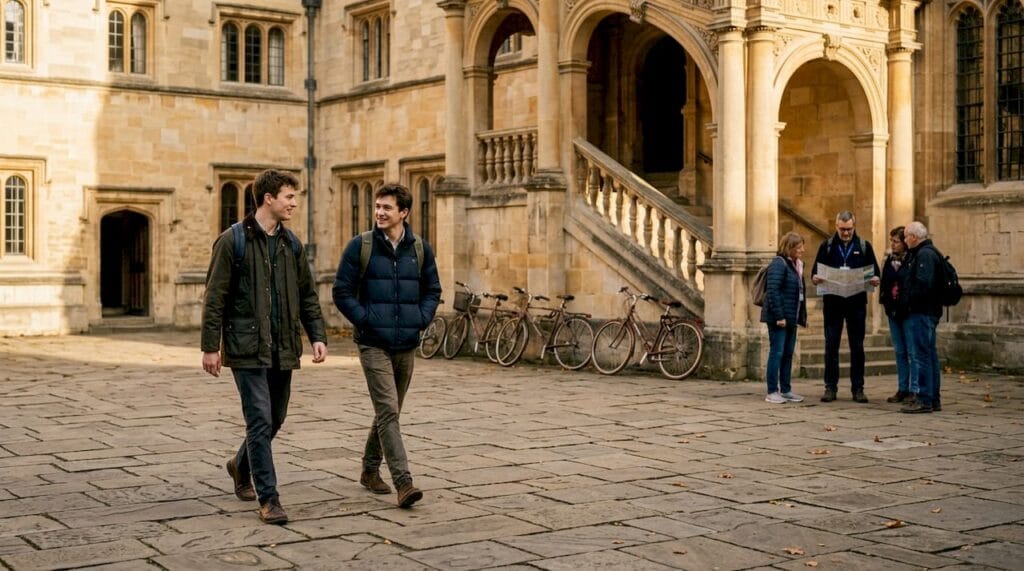
Over 200 film and television productions have been filmed at Oxford University, yet most people still assume movie magic happens entirely on studio lots. Oxford’s medieval streets, vaulted ceilings, and Gothic courtyards have quietly shaped some of cinema’s most beloved fantasy worlds. For Harry Potter fans and film enthusiasts, this city is not merely a backdrop. It is a living, breathing set that directors return to again and again. This guide walks you through the architecture, the iconic filming sites, the economics, and the realities behind Oxford’s remarkable cinematic identity, so you arrive knowing exactly what you are looking at.
Table of Contents
- Oxford’s architectural allure in cinema
- Iconic Harry Potter filming sites in Oxford
- Filming permissions and the Oxford experience
- Economic incentives and Oxford’s role in UK film industry
- A deeper look: What most guides miss about filming at Oxford
- Explore Oxford’s filming magic on a live walking tour
- Frequently asked questions
Key Takeaways
| Point | Details |
|---|---|
| Unique film backdrop | Oxford’s historic architecture offers authentic settings for fantasy and period films without heavy set dressing. |
| Harry Potter location magic | Several iconic scenes were filmed at real Oxford sites, letting visitors walk the same paths as movie favourites. |
| Permission and balance | Filming generates revenue and prestige but must balance student life with tourism and commercial interests. |
| Economic and industry incentives | UK film rebates and Oxford’s skilled crews make it attractive for international productions. |
| Experience via walking tours | Expert-led tours offer unique access and lively insights into Oxford’s cinematic sites and stories. |
Oxford’s architectural allure in cinema
When directors search for a location that feels genuinely ancient, they rarely need to look beyond Oxford. The city’s Gothic and medieval architecture provides something that no studio can fully replicate: authenticity. Stone staircases worn smooth by centuries of footsteps, cloisters bathed in filtered light, and dining halls with hammer-beam roofs all communicate a sense of history that audiences feel instinctively.
For fantasy films in particular, this matters enormously. Productions like Harry Potter benefit because Oxford’s historic Gothic architecture requires minimal set dressing to transform into a magical world. The bones of the story are already there in the stonework.
“The best film locations are the ones that do the acting for you. Oxford’s buildings carry centuries of narrative weight that no prop department can manufacture.”
Here is a snapshot of how Oxford stacks up against other popular UK filming locations:
| Location | Period architecture | Minimal set dressing needed | Fantasy film suitability |
|---|---|---|---|
| Oxford | Yes, Gothic and medieval | High | Excellent |
| Cambridge | Yes, Gothic | Moderate | Good |
| Edinburgh | Yes, Victorian and medieval | Moderate | Good |
| London (studio) | Varies | Low | Varies |
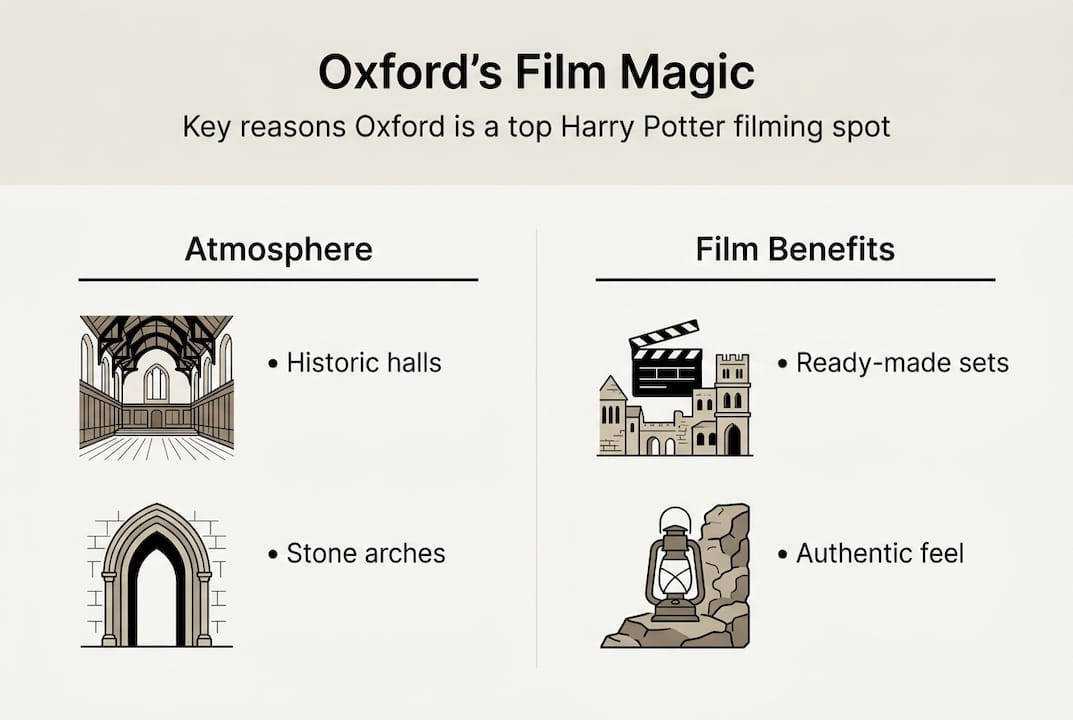
What makes Oxford stand out is the density of usable spaces within a compact area. Directors can move from a vaulted library to a cobbled courtyard to a grand staircase within minutes. This efficiency reduces production costs and scheduling complexity considerably.
Key architectural features that attract film crews include:
- Vaulted stone ceilings that create natural drama without lighting rigs
- Narrow medieval lanes that frame characters with organic depth
- Cloistered quadrangles offering controlled light and sound environments
- Grand staircases with sweeping visual impact
- Ornate dining halls that read as palatial on camera
Pro Tip: When visiting Oxford, look upwards. The vaulted ceilings in spaces like the Divinity School are the details that cinematographers treasure most, and they are easy to miss at ground level.
You can read more about the stories behind these spaces in our guide to Oxford landmarks explained, which covers the history that gives each building its distinctive character on screen.
Iconic Harry Potter filming sites in Oxford
Knowing that Harry Potter was filmed in Oxford is one thing. Knowing precisely where to stand, what to look for, and which scenes unfolded in which rooms is quite another. Key Harry Potter filming locations include Christ Church, the Bodleian Library, and New College, each contributing distinct scenes to the series.
Here is a comparison of the three principal sites:
| Location | Scene filmed | Film appearance |
|---|---|---|
| Christ Church, Bodley Staircase | Harry and students arrive at Hogwarts | Philosopher’s Stone |
| Bodleian Library, Divinity School | Hospital wing scenes | Philosopher’s Stone, Chamber of Secrets |
| New College cloisters | Draco Malfoy and the ferret scene | Goblet of Fire |
Visiting these sites in sequence gives you a genuine sense of how the film-makers stitched Oxford’s spaces together to construct Hogwarts. The geography of the fictional school does not map neatly onto Oxford, which is part of what makes the experience so fascinating.
Here is how to make the most of each location:
- Christ Church: Enter via the Tom Tower and make your way to the Bodley Staircase. Stand at the base and look upward to see exactly what Harry saw on his first night at Hogwarts.
- Bodleian Library, Divinity School: Book a guided visit in advance. The room is used for university ceremonies today, and its fan-vaulted ceiling is extraordinary in person.
- New College cloisters: Walk slowly through the covered walkways and notice how the light falls between the stone columns. This is the atmosphere the Goblet of Fire production team wanted to capture.
Pro Tip: Ask your guide which scenes were genuinely filmed on location versus those merely inspired by Oxford interiors. For example, the Great Hall at Hogwarts was inspired by Christ Church’s dining hall but was actually built as a set at Leavesden Studios.
For a fuller picture of what to expect, our tour highlights page covers the key stops in detail. You can also explore our advice on how to enjoy Harry Potter sites at Oxford University for practical visitor tips. Productions such as My Oxford Year have also used the city’s streets extensively, adding fresh layers to its cinematic catalogue.
Filming permissions and the Oxford experience
Oxford’s colleges are not passive backdrops. Each one is a functioning academic institution that must weigh the benefits of filming against the disruption it causes. Oxford University grants filming permissions to productions like Harry Potter, enhancing prestige and generating income, but the process involves careful negotiation.
The key considerations for any college granting permission include:
- Timing: Productions must avoid examination periods and major academic events
- Access restrictions: Certain rooms and courtyards may be off-limits to protect student privacy
- Revenue sharing: Colleges negotiate fees directly with production companies
- Crew conduct: Strict guidelines govern noise levels, equipment placement, and working hours
- Restoration obligations: Productions must return spaces to their original condition
The financial picture is more nuanced than most visitors realise. Oxford’s tourism generates £780m per year, and filming contributes to that figure indirectly by raising the city’s global profile. However, the direct income from filming permissions is modest compared to tuition fees and academic funding.
Filming also has measurable effects on student applications. Filming disrupts exams but boosts applications, with Magdalen College receiving 2,503 applicants in a recent cycle, a figure partly attributed to its cinematic visibility.
Pro Tip: If you want to visit filming locations with fewer restrictions and smaller crowds, plan your trip during Oxford’s academic vacation periods, typically July to September and late December to January.
The tension between Oxford’s identity as a world-class university and its role as a cinematic destination is something our guide to identity at Oxford University explores in depth. For a broader view of how streaming platforms use Oxford, the Netflix My Oxford Year production offers a useful contemporary case study.
Economic incentives and Oxford’s role in UK film industry
Oxford does not exist in isolation. Its appeal to film-makers is amplified by the broader economic environment that makes the United Kingdom one of the world’s most attractive production destinations.
UK film and high-end television spend reached £6.8bn in 2025, up 22% on the previous year. That figure reflects the scale of international investment flowing into British productions, and Oxford sits at the prestigious end of that ecosystem.
The financial mechanics work as follows:
| Incentive | Detail | Benefit to Oxford productions |
|---|---|---|
| AVEC tax credit | Up to 25.5% to 29.25% on qualifying spend | Reduces overall production cost |
| Skilled crew base | Concentrated in Oxford and surrounding areas | Reduces travel and accommodation costs |
| Historic location value | Authentic settings reduce set-building spend | Direct saving on production budgets |
The UK’s film incentives make filming economically viable for productions that might otherwise choose European or North American locations. Oxford benefits from this national framework while adding its own unique assets.
Factors that strengthen Oxford’s position in the UK film ecosystem include:
- A concentration of highly educated local talent available for supporting roles and crew positions
- Proximity to London and major studio facilities at Pinewood and Leavesden
- A city infrastructure accustomed to managing large visitor numbers
- Strong relationships between colleges and established production companies
For a deeper look at why this combination works so effectively, our article on Oxford as a film hotspot sets out the full picture.
A deeper look: What most guides miss about filming at Oxford
Most guides celebrate Oxford’s cinematic credentials without acknowledging the trade-offs. Here is the reality: filming in Oxford is not always the glamorous partnership it appears to be.
Filming boosts tourism at £780m per year and raises Oxford’s international profile considerably. But street closures, exam disruptions, and restricted access to college spaces create genuine friction for students and residents. The income colleges receive from filming permissions is modest when set against tuition revenue, which means the financial argument for granting access is often more about prestige than profit.
What this means for visitors is important. The most memorable Oxford experiences are not the ones where you stand at a distance and photograph a famous staircase. They are the ones where someone knowledgeable explains the full story, including the compromises, the politics, and the moments when the cameras were not rolling. Choosing a guided tour that addresses both the magic and the messiness gives you a far richer understanding of Oxford as a film hotspot than any self-guided walk can offer.
Pro Tip: Choose guided tours that candidly address both the perks and the pitfalls of filming in Oxford. The best guides will tell you what the brochures leave out.
Explore Oxford’s filming magic on a live walking tour
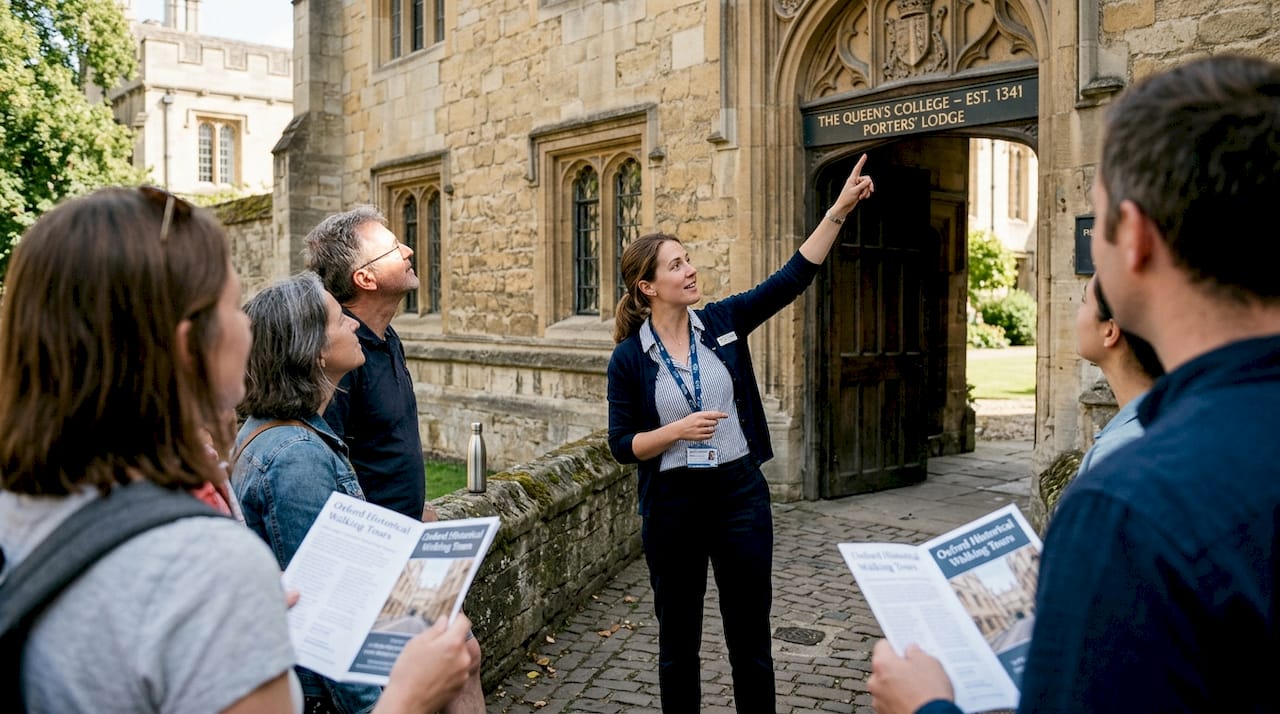
Understanding Oxford’s cinematic history is one thing. Experiencing it with a live guide who brings each location to life is something else entirely. Our Harry Potter filming locations walking tour takes you to the exact spots where iconic scenes were captured, with expert commentary woven through every stop.
What makes our tours genuinely different is the live entertainment. Our magician has performed for the British Royal Family and A-list celebrities, and he brings that same calibre of performance to every Oxford tour. If you are ready to visit Oxford filming locations with a guide who knows both the history and the craft, our Oxford walking tours page has everything you need to book your place.
Frequently asked questions
Which Oxford locations were actually used in the Harry Potter films?
Christ Church’s Bodley Staircase, Bodleian Library, and New College cloisters all appeared in authentic film scenes, each contributing distinct moments to the series.
Are all the filmed interiors at Oxford real or were some recreated elsewhere?
Some interiors were inspired by Oxford but built as sets elsewhere. Christ Church’s Great Hall inspired Hogwarts’ dining hall but the actual filming took place at Leavesden Studios.
How can I visit Oxford’s filming locations?
Guided walking tours offer the most rewarding way to access and understand the notable Harry Potter film sites, combining expert knowledge with live entertainment.
Does filming in Oxford disrupt university life?
Filming disrupts exams and daily routines but simultaneously boosts student applications and contributes to the city’s £780m annual tourism economy.
What incentives attract film productions to Oxford?
UK tax credits up to 29.25% on qualifying spend, combined with Oxford’s skilled crews and irreplaceable historic settings, make it a compelling choice for large-scale productions.