TL;DR:
- An interactive tour transforms sightseeing into a participatory experience through storytelling, live performance, and hands-on elements. It enhances memory and emotional connection by actively involving guests rather than passive observation, making it ideal for families, Harry Potter fans, and social groups. Oxfordmagictours offers a unique walking tour with a professional magician, blending magic, history, and film locations in an immersive narrative.
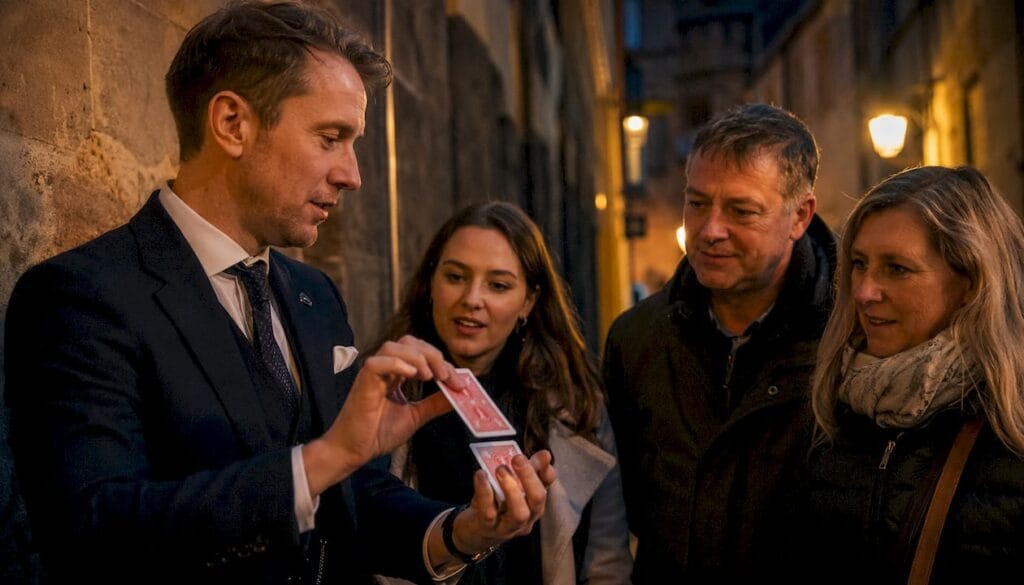
An interactive tour is a guided experience where you become an active participant rather than a passive observer, drawn in through live performance, storytelling and hands-on elements. At Oxfordmagictours, that means a professional magician leads you through Oxford University’s historic courtyards and Oxford Harry Potter filming locations, performing illusions at the very spots where Hogwarts scenes were shot. If you want theatrical, participatory sightseeing rather than a lecture-style walk, this is the format for you.
Table of Contents
- How interactive tours differ from traditional guided walking tours
- Core elements you will find on an immersive walking tour
- What to expect on an immersive walking tour in Oxford
- Who benefits most from an interactive tour?
- How skilled guides create participation and memorable stories
- Booking options, private groups and safety in the UK
- Key takeaways
- Why interactive tours work especially well in Oxford
- Oxfordmagictours: Oxford’s live-magic walking tour
- Useful sources and further reading
How interactive tours differ from traditional guided walking tours
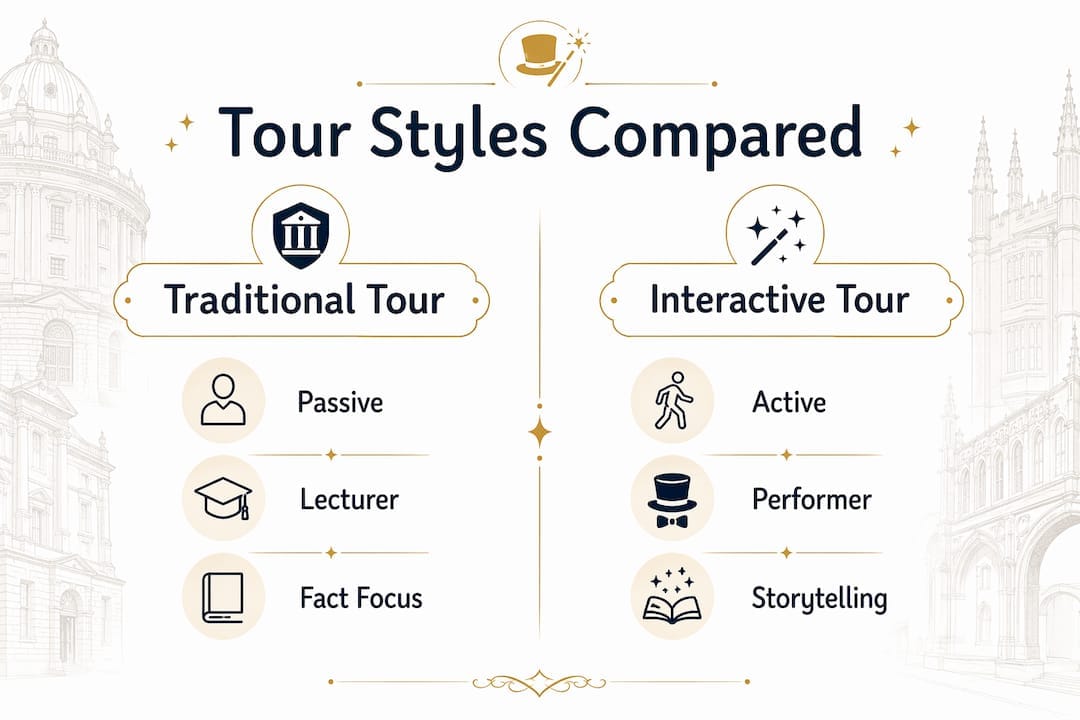
The simplest way to put it: a traditional tour asks you to listen; an interactive tour asks you to take part. The guide’s role shifts from lecturer to performer and host, the structure shifts from a sequence of facts to a coherent world with its own narrative, and your role shifts from spectator to co-creator of the experience.
| Aspect | Traditional tour | Interactive tour |
|---|---|---|
| Guide role | Lecturer delivering facts | Performer, storyteller, host |
| Guest activity | Passive listening | Participation, role-play, challenges |
| Experience outcome | Information recalled | Emotional memory and shared moments |
That shift in guest activity is not cosmetic. Active participation causes deeper memory formation and more natural learning, which is why operators design participatory moments deliberately into every itinerary rather than leaving them to chance.
Core elements you will find on an immersive walking tour
Genuine interaction shows up in a handful of recognisable building blocks. Knowing them helps you spot the real thing on any booking page.
- Hands-on props and tactile items. A guide might hand you a replica artefact, a period document, or a conjuring prop at a key stop.
- Live theatrical performance. On a magic-led walk, illusions are performed at specific locations, not described after the fact.
- Sensory and narrative anchors. Each stop connects to the last through a running story, so the route feels like a world rather than a list of addresses.
- Group challenges and role-play. Collaborative tasks, short puzzles or character-based scenarios build group energy and shared memory.
- Reveal moments and deliberate pacing. Experience designers recommend using tempo changes the way music does: quieter passages make the high moments hit harder.
At Oxfordmagictours, the magician uses the gate of a college, a cloister corridor, or a filming courtyard as a stage. The architecture is not backdrop; it is a prop in the story. That is what separates an immersive walk from a standard tour of the same locations.
What to expect on an immersive walking tour in Oxford
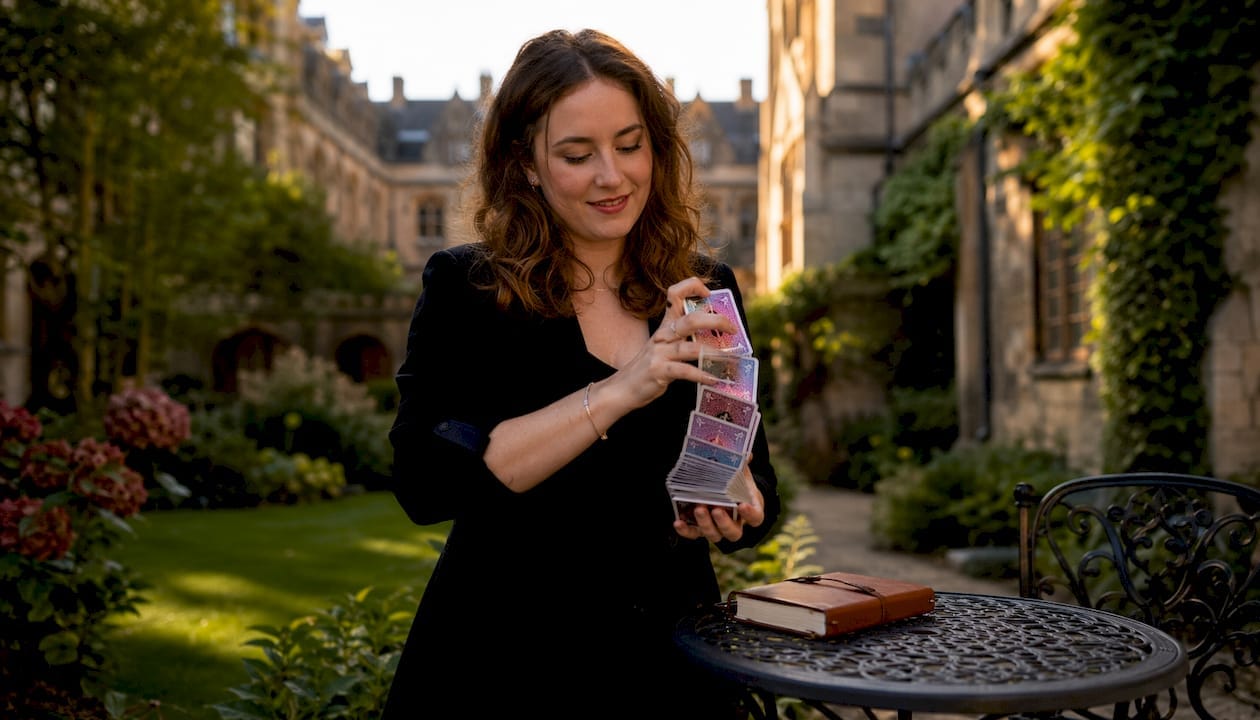
Most public sessions at Oxfordmagictours run for around an hour and a half at a relaxed walking pace, with natural pauses built in at performance stops. Group sizes are kept small enough for everyone to see the magic clearly. Ticketed sessions are available at scheduled times, and private group bookings can be arranged for bespoke routes and timings.
Pricing varies by tour type and group size; check the booking page for current rates rather than relying on third-party listings.
What to bring:
- Comfortable, flat-soled shoes — cobbled Oxford streets are uneven
- Layers for British weather (a light waterproof is rarely wasted)
- A charged phone if you want photos at the filming locations
- Nothing else is required; props are provided
Pro Tip: Book themed slots, particularly the Harry Potter and magic-led walks, well in advance. These sell out faster than standard city tours, especially during university open days and school holidays.
Who benefits most from an interactive tour?
The format suits some visitors far better than others. Here is an honest breakdown.
Interactive tours are a strong fit for:
- Families with children. Live magic holds attention in a way that a monologue cannot. Children remember what they participated in, not what they were told.
- Harry Potter fans. Seeing the actual filming locations at Oxford University while a magician performs at them is a different experience from simply standing in the same courtyard.
- Small groups and social occasions. Stag and hen parties, birthday groups and corporate teams find that shared challenges and theatrical moments create genuine bonding.
- Curious learners. If you absorb history better through story than through dates, the immersive format is built for you.
Visitors who prefer a quieter, self-directed experience may find the participatory elements less comfortable. For anyone with mobility considerations or sensory sensitivities, private tours allow the operator to adjust pace, route and interaction level. It is worth contacting Oxfordmagictours directly before booking to discuss specific needs.
How skilled guides create participation and memorable stories
Participation does not happen by accident. It is orchestrated through pacing, expectation-setting and repeated sensory anchors from the first minute of the tour.
Guide and educator Claire Bown recommends setting interaction expectations at the very start: tell guests what kind of experience this is, invite them in, and use visual aids and deliberate pauses throughout to give them agency rather than just information.
In practice, that looks like this on a magic-led Oxford walk:
- The guide opens with a brief framing of the “world” you are about to enter, so guests know participation is expected and welcome.
- Two-way conversation prompts at each stop replace one-way narration; guests are asked questions, not just given answers.
- The magician’s role in the tour is to create reveal moments that punctuate the storytelling, using the physical space as a stage.
- Role-play and group challenges are staged in open public areas with clear sight lines, keeping the flow safe and inclusive regardless of group size.
The craft behind this is what interpretive guiding training describes as building bridges between landscapes, people and history — not just reciting facts at a location.
Booking options, private groups and safety in the UK
Oxfordmagictours offers three booking routes: public scheduled sessions, ticketed themed events (magic and Harry Potter), and private group hires with bespoke routes.
Before you book, ask:
- What is the maximum group size for this session?
- What happens if the weather is severe? Is there a contingency or rescheduling policy?
- How much physical interaction is involved, and can it be adjusted for accessibility needs?
- What is the private-group pricing and minimum number?
Safety and permissions checklist:
- All performance activity takes place in publicly accessible spaces; no private-access fees are required for standard routes.
- Crowd management is built into the small-group format; the guide controls pacing to avoid blocking pedestrian flow.
- Props used in magic demonstrations are safe for all ages and require no guest preparation.
- Public performance in the UK is generally permitted in open public spaces, though operators are responsible for ensuring their activities comply with any local council conditions that apply to their specific route.
Special access moments and crafted theatrical stops are also what justify premium pricing for private hires, so it is worth asking what exclusive elements a bespoke booking includes.
Key takeaways
An interactive tour replaces passive listening with live performance, storytelling and hands-on participation, making it the format best suited to visitors who want to feel part of the story rather than observe it from a distance.
| Point | Details |
|---|---|
| Core definition | Guests participate actively via storytelling, live performance and hands-on elements rather than listening passively. |
| Memory and learning | Active participation creates deeper emotional memory than observation alone, by design. |
| Practical prep | Wear flat, comfortable shoes; bring layers; book themed slots well in advance as they sell out. |
| Who it suits | Families, Harry Potter fans, social groups and curious learners gain the most from the format. |
| Oxfordmagictours | Oxford’s only walking tour with a live magician, covering Oxford University and Harry Potter filming locations. |
Why interactive tours work especially well in Oxford
Oxford is an unusual city for this format. The architecture is not merely old; it is actively storied. Colleges that appear in the Harry Potter films are still in daily use, which means a guide performing magic in a courtyard is doing so in a space that carries genuine cinematic and academic weight simultaneously.
What the research on immersive tourism consistently shows is that emotional connection to a place deepens when visitors are given agency within it, not just information about it. Oxford’s density of meaningful locations within walking distance makes it particularly well-suited to a format that links stops into a coherent narrative world.
The credential that matters here is not just knowledge of the locations. Oxfordmagictours’ magician has performed for the British Royal Family and A-list celebrities, which means the theatrical quality on a public walking tour is not amateur dramatics. That level of performance craft, applied to a 90-minute walk through one of the world’s most recognisable university cities, is what makes the format genuinely different from anything else available in Oxford.
Oxfordmagictours: Oxford’s live-magic walking tour
Oxford has plenty of walking tours. Only one puts a professional magician, with Royal Family performance credits, at the centre of the experience. Oxfordmagictours covers Oxford University’s most iconic courtyards and the Harry Potter filming locations that draw visitors from around the world, weaving live illusions into the route so the history and the magic arrive together.
Public sessions run at scheduled times and are suitable for families, couples and solo travellers. Private group bookings are available for bespoke routes, corporate events, school trips and special occasions, with interaction levels adjusted to suit your group. Book your place on the walking tours page and choose the session that fits your visit.
Useful sources and further reading
- GuestFocus: Interactive Tour Design — industry framework covering participation types, the experience pyramid and how operators design memorable moments deliberately.
- GuestFocus: Creating Memorable Tours (SPAM framework) — links special access and crafted moments to commercial outcomes for tour operators.
- Thinking Museum: 10 easy ways to make your guided tours more interactive — Claire Bown’s practical guide techniques including expectation-setting and visual aids.
- Experiences.link: How to design a tour that feels like a world — design theory on pacing, sensory anchors and emotional intention.
- NYCFreeTour: What makes a great guided walking tour experience? — practical guide on the storyteller-host role and guest preparation advice.
- Flight of Aloha: Interactive tourism explained — industry perspective on how participatory elements elevate visitor engagement across tour formats.
- Oxfordmagictours: Walking tours of Oxford — booking page for public and private sessions, route details and themed tour schedules.