
TL;DR:
- Alumni significantly influence Oxford’s cultural and physical landscape through philanthropy, tradition, and leadership.
- They fund buildings, support arts and mentorship, and help maintain the university’s global reputation.
- Engagement from alumni fosters a dynamic, inclusive community that shapes Oxford’s identity and legacy.
Oxford alumni contribute far more than the occasional cheque. A single gift from Stephen A. Schwarzman, a £185 million donation for a new humanities centre, illustrates just how dramatically alumni can reshape the physical and cultural fabric of the university. Yet money is only part of the story. Alumni organise traditions, mentor students, lead global networks, and hold positions that influence everything from governance to the arts. Whether you graduated last year or decades ago, understanding this web of influence helps you see Oxford not as a static institution, but as a living community shaped by the people who pass through it.
Table of Contents
- How alumni contributions transform Oxford’s cultural landscape
- Alumni as stewards of tradition and community
- The global reach of Oxford alumni communities
- Alumni, leadership, and the advancement of university culture
- The traditional Oxford alumni role: time for a rethink?
- Discover Oxford’s culture first-hand with our walking tours
- Frequently asked questions
Key Takeaways
| Point | Details |
|---|---|
| Alumni power cultural change | Oxford alumni fund major projects and fuel vibrant arts life, shaping campus culture for all. |
| Traditions thrive with alumni | Long-standing and evolving traditions are kept alive by engaged alumni communities and college groups. |
| Global networks amplify impact | Alumni societies connect graduates across the world, spreading Oxford’s values and supporting students everywhere. |
| Leadership and patronage matter | Influential alumni roles and modern patronage link new generations with Oxford’s heritage and opportunity. |
| Balance heritage and progress | Alumni can help Oxford embrace both tradition and change, fostering a culture that’s inclusive and dynamic. |
How alumni contributions transform Oxford’s cultural landscape
With the scale of alumni impact in mind, it is essential to see how these contributions materialise on campus. The most visible form of alumni influence is philanthropic giving, and the numbers are striking. The Schwarzman Centre for the Humanities stands as the most prominent recent example, a purpose-built space that brings together faculties, performance venues, and public programming under one roof. It is not simply a building. It is a statement about what Oxford values and who helps define those values.
But financial contributions take many forms beyond landmark gifts. Alumni donate art collections, fund student bursaries, sponsor lecture series, and endow professorships. Each of these acts quietly shapes what students encounter during their time at Oxford, from the paintings on college walls to the visiting speakers in seminar rooms.
| Type of contribution | Example | Cultural impact |
|---|---|---|
| Major philanthropy | Schwarzman Centre | New humanities hub and performance space |
| Art donations | College portrait collections | Visual identity and historical narrative |
| Bursaries and awards | Music and drama prizes | Encourages student participation in the arts |
| Programming support | Alumni-curated events | Brings professional artists back to campus |
Alumni also support cultural programmes that feature prominent alumnae artists, creating a feedback loop where Oxford-trained creatives return to inspire the next generation. This is not passive generosity. It is active cultural curation.
“Artists are the great convenors,” as one Oxford alumni feature puts it, capturing the idea that creative alumni do not just donate money — they bring people together around shared ideas and experiences.
For students, this means access to a cultural environment that no university budget alone could sustain. For alumni, it is a way of remaining genuinely connected to Oxford culture and traditions rather than simply receiving a quarterly newsletter. The relationship is reciprocal, and that is what makes it so enduring.
- Financial gifts fund buildings, chairs, and scholarships
- Art donations shape the visual culture of college spaces
- Programming contributions bring professional artists and thinkers to campus
- Mentorship and networking create invisible but powerful cultural infrastructure
Alumni as stewards of tradition and community
Just as philanthropy shapes the visible campus, alumni traditions quietly anchor Oxford’s identity. College alumni groups are perhaps the most underappreciated force in preserving what makes Oxford feel like Oxford. The Orieladelphians, the alumni society of Oriel College, offer a compelling illustration. After 50 years of sustained involvement, the group has funded a music room and established awards that continue to support students today. That kind of long-term commitment is not accidental. It reflects a genuine sense of ownership over the college’s identity.

Alumni-run efforts often differ from university-led programmes in one important way: they are driven by personal attachment rather than institutional obligation. That emotional investment tends to produce more creative and more durable results.
| Feature | Alumni-run programmes | University-led efforts |
|---|---|---|
| Motivation | Personal connection and loyalty | Institutional mandate |
| Flexibility | High, can adapt quickly | More structured and formal |
| Longevity | Often spans decades | Dependent on funding cycles |
| Student engagement | Peer-to-peer and mentorship-led | Formal and programme-based |
If you want to engage with these traditions, here is a practical starting point:
- Join your college’s alumni society and attend at least one annual event
- Volunteer for mentorship schemes run by your college or department
- Attend public lectures or cultural events organised by alumni groups
- Contribute to alumni publications or oral history projects
- Support student arts awards or bursaries through your alumni network
The alumni influence on traditions is often invisible to outsiders, but students and graduates feel it constantly. It shows up in the music played at formal hall, the portraits in the common room, and the annual events that mark the rhythm of college life. Understanding this, as explored in explaining tradition, helps both current students and returning alumni appreciate what they are actually participating in.
Pro Tip: If you are a recent graduate unsure how to stay connected, start small. Attending a single alumni event at your college is often enough to find your footing and discover where your interests align with ongoing initiatives.
The global reach of Oxford alumni communities
While traditions thrive locally, the alumni community’s influence extends well beyond Oxford’s walls. Oxford has around 170 alumni groups operating worldwide, collectively serving approximately 400,000 alumni. These are not passive mailing lists. They organise cultural events, run outreach programmes, offer bursaries, and act as genuine ambassadors for the university in their regions.
400,000 alumni connected globally through 170+ groups — making Oxford’s community one of the most internationally active of any university.
The Shanghai Oxford Society provides a vivid example of what this looks like in practice. The group has been involved in supporting climate ventures, connecting Oxford’s academic expertise with real-world challenges on the other side of the world. That is not a footnote in the university’s story. It is evidence that Oxford’s cultural and intellectual influence travels with its graduates.
- Alumni groups host cultural evenings, film screenings, and academic talks in their cities
- Regional groups connect newly arrived Oxford students with established local alumni
- Bursary schemes funded by overseas alumni support access for future students
- Global networks create career pathways that extend Oxford’s reach into every major industry
For current students, this global infrastructure is genuinely useful. Knowing that an Oxford alumni group exists in the city where you hope to work is not a trivial detail. It is a practical resource. For alumni, being part of these groups is a way of keeping Oxford’s global influence alive and relevant in their own professional and social lives.
Pro Tip: If you are based outside the UK, search the Oxford Alumni Groups directory before your next move abroad. Connecting with a local group before you arrive can make an enormous difference to how quickly you settle in and build a professional network.
Alumni, leadership, and the advancement of university culture
Alumni influence is not just grassroots; it often sits at the pinnacle of decision-making. When William Hague was inaugurated as Chancellor, he brought with him a public commitment to championing philanthropy and diversity within the university. That is a significant signal. The Chancellor role is largely ceremonial, but the values a Chancellor publicly endorses shape the conversation about what Oxford should be and who it should serve.
Beyond formal leadership, alumni shape culture through patronage systems involving honorary degrees and high table dinners. These traditions connect students and academics with networks of influence that extend far beyond the university. They also raise questions about access and equity, which is precisely why alumni in leadership roles matter so much.
- Alumni chancellors and vice-chancellors set the tone for institutional values
- Honorary degree recipients bring external prestige and signal Oxford’s priorities
- High table networks create connections between students and influential figures
- Alumni-led diversity initiatives push for broader representation in admissions and staffing
“Patronage at Oxford is not a relic. It is a living system that, when used well, creates genuine opportunity for students who might otherwise never access these networks.”
This is where what sets Oxford apart becomes most apparent. The combination of historical prestige and active alumni engagement creates a cultural environment that is genuinely difficult to replicate. Alumni in leadership do not just preserve Oxford’s prestige. At their best, they expand it by making it more inclusive and more relevant to the world beyond the dreaming spires.
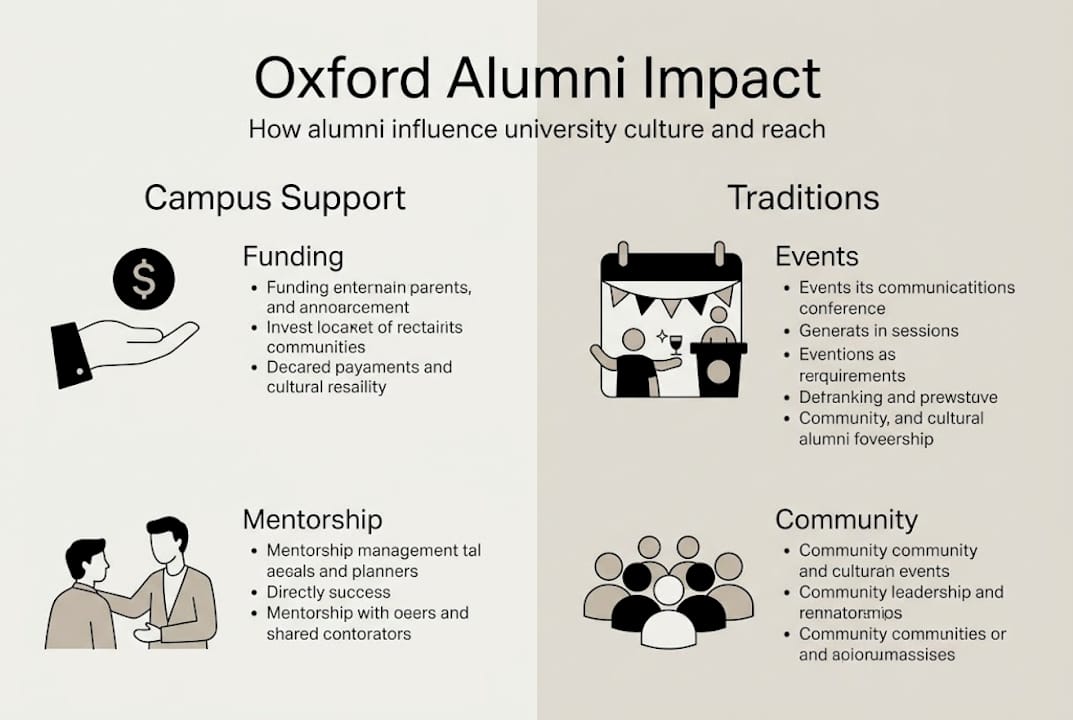
The traditional Oxford alumni role: time for a rethink?
Here is an uncomfortable truth: not all alumni influence is straightforwardly positive. Some of Oxford’s most cherished traditions carry complicated legacies. College portraits, for instance, have provoked genuine debate about whose history gets celebrated and whose gets overlooked. When the faces on the walls of a dining hall reflect a narrow slice of Oxford’s past, that sends a message to current students about who this place was built for.
Alumni who want to make a meaningful contribution in 2026 need to reckon with this tension. Preserving tradition and challenging tradition are not opposites. The most thoughtful alumni engagement we have seen involves people who love Oxford deeply enough to push it towards something better. That might mean funding portraits of contemporary figures, supporting first-generation student networks, or simply showing up to conversations about what the university’s culture should look like going forward. The alumni who shape campus lore most effectively are those who hold the past and the future in the same hand, honouring what is worth keeping while making space for what needs to change.
Discover Oxford’s culture first-hand with our walking tours
The best way to understand these influences? See them in person. Our Oxford walking tours take you through the very streets, colleges, and courtyards where alumni history comes alive. Whether you are a returning graduate wanting to reconnect with the city or a current student curious about the stories behind the buildings, our tours offer something genuinely different. We are the only walking tour in Oxford to feature live entertainment from a magician who has performed for the British Royal Family and A-list celebrities. You can explore alumni stories woven into the fabric of the city, or simply learn more about our tours and find the experience that suits you best.
Frequently asked questions
How do Oxford alumni support current students?
Alumni offer mentorship, bursaries, and networking opportunities, with alumni groups organising outreach and student support activities across the globe.
What is the Schwarzman Centre and why is it significant?
The Schwarzman Centre is a landmark humanities facility funded by a £185 million alumni gift, hosting cultural programmes and transforming arts provision at Oxford.
How are global alumni communities involved with Oxford?
Over 170 groups worldwide serve as cultural ambassadors, connecting 400,000 alumni and supporting students internationally through events and bursaries.
Can alumni influence Oxford’s governance and culture?
Yes, alumni hold leadership positions and shape policy, with figures like William Hague as Chancellor championing philanthropy and diversity at the highest level.
What if I want to reconnect with Oxford’s traditions as an alum?
Join your college’s alumni group or attend a cultural event. College alumni groups sustain traditions and offer practical ways to stay genuinely connected to Oxford’s living culture.