
TL;DR:
- Guided tours provide expert knowledge and handle logistics, offering a structured experience with less responsibility for travelers. Self-guided tours grant full control over pacing and routes but require planning and technology reliance. The best choice depends on travel experience, destination complexity, and personal preferences.
The difference between self-guided and guided tours is fundamentally a choice between control and convenience. A guided tour is a structured, expert-led experience where a professional guide manages your itinerary, provides historical and cultural context, and handles logistics on your behalf. A self-guided tour places every decision in your hands: where to go, how long to stay, and which route to take. Both formats have genuine strengths, and the right choice depends on your travel style, budget, and destination.
What is the difference between self-guided and guided tours?
The clearest way to understand the distinction is through what each format gives you and what it takes away. Guided tours offer expert knowledge that enriches your experience beyond what any guidebook or app can replicate. A skilled guide at a place like Oxford University does not simply point at buildings. They tell you which scenes from the Harry Potter films were shot in the Divinity School, why Christopher Wren designed the Sheldonian Theatre the way he did, and which college bar has been serving students since the 1600s. That depth of context is the core guided tour advantage.

Self-guided tours, by contrast, give you complete control over pace and itinerary. You linger where you want and skip what does not interest you. The trade-off, as resources like Macs Adventure note, is that you carry the full weight of planning: checking opening hours, booking timed tickets, and managing transport connections yourself.
The core distinction, then, is this: guided tours trade freedom for effortless insight, while self-guided tours trade convenience for autonomous exploration.
What are the advantages and disadvantages of guided tours?
Guided tours deliver the most value when a destination is complex, historically layered, or logistically demanding. Carol Howard Tours describes the guided experience as one where expert commentary transforms a visit from sightseeing into genuine understanding. That is a meaningful difference, particularly for first-time visitors.
The main advantages of guided tours
- Expert context: A professional guide provides historical, cultural, and local knowledge that no app fully replicates.
- Logistical ease: Transport, entrance fees, and scheduling are handled for you, often at bundled group rates that reduce individual costs.
- Safety infrastructure: Guided tour operators maintain emergency response systems that monitor weather, health alerts, and local conditions. Independent travellers must manage all of this themselves.
- Exclusive access: Some guided adventure tours include specialised equipment or site access that is impractical to arrange independently.
- Social connection: Group tours create natural opportunities to meet fellow travellers with shared interests.
The main disadvantages of guided tours
- Fixed schedules: You move at the group’s pace, not your own. According to The Points Guy, average group sizes run between 24 and 36 participants. That number affects how quickly a group moves and how much individual attention you receive.
- Less spontaneity: Detouring to a side street café or spending an extra hour in one room of a museum is rarely possible on a structured tour.
- Higher upfront cost: Guide fees and group logistics add to the price, even when bundled costs offer value overall.
Pro Tip: If you are joining a large group tour, arrive a few minutes early and position yourself near the guide. You will hear more clearly and have a better chance of asking questions without competing with 30 other people.
What are the benefits and challenges of self-guided tours?
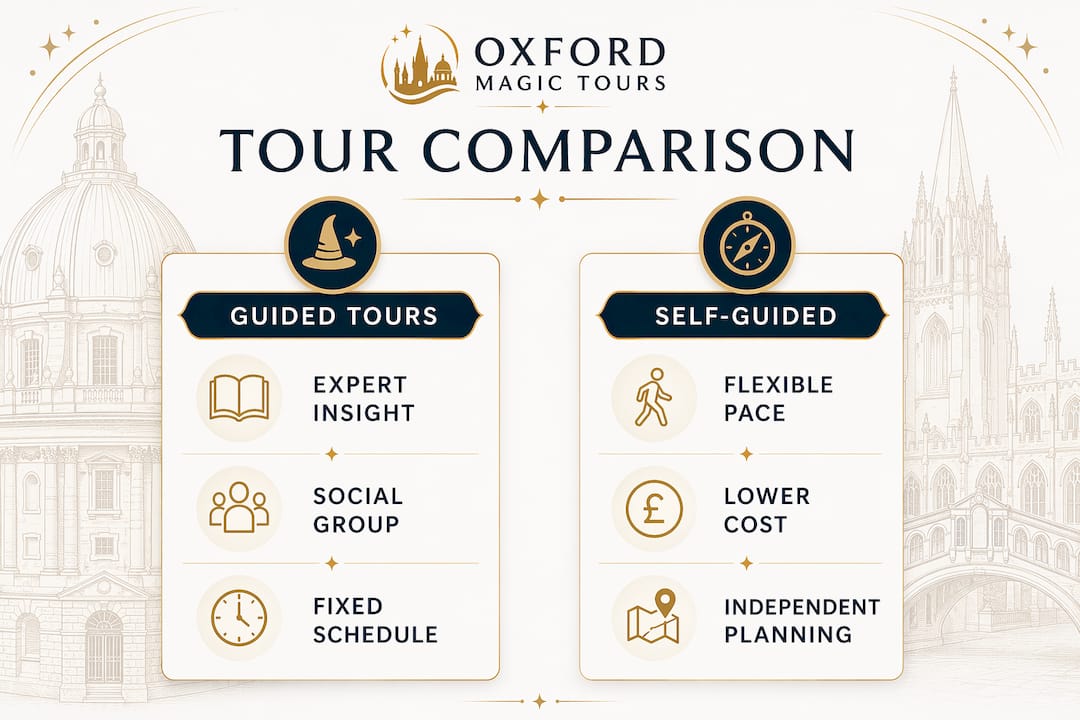
Self-guided tours suit travellers who know what they want and are willing to do the groundwork to get it. The self-guided tour benefits are real and significant, particularly for families, budget travellers, and those with very specific interests.
Why self-guided tours work well
- Full flexibility: You set the pace, the route, and the duration. Spend three hours in one gallery if you wish, or skip an attraction entirely without inconveniencing anyone.
- Lower cost: Removing professional guide fees and using free or low-cost digital resources makes self-guided travel genuinely affordable. Families in particular benefit from this cost structure.
- Privacy and depth: Without a group dynamic, you can engage with a place on your own terms. Many travellers find this leads to more memorable, personal discoveries.
- Off-the-beaten-path access: You are not constrained by a pre-set route, so you can follow curiosity into quieter streets and lesser-known spots.
The real challenges of self-guided travel
- Logistics fall entirely on you: Managing timed tickets, transport schedules, and opening hours is your responsibility. Guided tours absorb all of this effort automatically.
- Technology dependence: Successful self-guided travellers rely on GPS apps and offline maps, downloading content on reliable Wi-Fi before they arrive. Connectivity problems in historic city centres or remote locations can derail plans quickly.
- Safety: Without a guide monitoring local conditions, you are responsible for your own situational awareness and contingency planning.
Pro Tip: Download offline maps and audio guides for your destination before you leave your accommodation each morning. Historic city centres like Oxford have notoriously patchy mobile signal in narrow lanes and college courtyards.
How do the costs of self-guided and guided tours compare?
Cost is one of the most common deciding factors when choosing between tours, and the picture is more nuanced than it first appears.
| Factor | Guided tours | Self-guided tours |
|---|---|---|
| Upfront price | Higher, due to guide fees and group logistics | Lower, as you pay only for what you use |
| Cost predictability | High. Bundled pricing covers most expenses | Variable. Last-minute bookings can increase costs |
| Group rate savings | Yes. Transport and entry fees at group rates | No. Individual rates apply throughout |
| Hidden effort costs | Low. Logistics are managed for you | High. Planning time has a real personal cost |
| Family or group value | Moderate. Per-person fees add up | Strong. Fixed costs spread across the group |
Guided tours bundle transport, accommodation, and entrance fees at group rates, which can make the total cost more competitive than it appears. Self-guided tours are cheaper on paper, but variable costs from last-minute bookings or missed pre-sale tickets can close that gap. The honest comparison is not just price per person. It is price per unit of experience, including the time and stress you either spend or save.
When should you choose a guided tour over self-guided travel?
The right format depends on the destination, your experience level, and your personality as a traveller. Guided tours are better for complex destinations with language barriers, confusing transport networks, or significant safety considerations. Self-guided travel suits well-mapped cities and travellers with specific, personal interests.
Here are the clearest scenarios for each choice:
- Choose a guided tour if you are visiting for the first time. Expert guides compress years of local knowledge into a single walk. A first visit to Oxford, for example, benefits enormously from a guide who can explain the collegiate system, point out filming locations, and share stories that no map provides.
- Choose a guided tour if the destination has a language barrier. Navigating transport, menus, and ticketing systems in an unfamiliar language adds friction that a guide eliminates entirely.
- Choose a guided tour if time is limited. A structured itinerary maximises the highlights without the risk of spending two hours trying to find a car park or a ticket office.
- Choose a self-guided tour if you are an experienced traveller who has visited the destination before or who researches thoroughly in advance.
- Choose a self-guided tour if your interests are highly specific. If you want to spend an entire afternoon in one college library or photograph every Harry Potter filming location at your own pace, a group tour will frustrate you.
- Consider a hybrid approach. Many experienced travellers take a guided orientation tour on their first day, then spend subsequent days exploring independently. This gives you the expert foundation and the freedom to build on it.
Traveller personality matters more than most people admit. Social travellers who enjoy meeting others and sharing reactions tend to get more from guided group experiences. Those who value quiet, privacy, and the freedom to change plans mid-morning are almost always happier going self-guided.
Key takeaways
The most effective way to choose between a guided and self-guided tour is to match the format to your destination’s complexity, your available time, and your personal travel style.
| Point | Details |
|---|---|
| Core distinction | Guided tours offer expert-led convenience; self-guided tours offer full personal control. |
| Cost reality | Guided tours cost more upfront but bundle logistics; self-guided costs vary with planning effort. |
| Safety and logistics | Guided operators manage emergencies and schedules; self-guided travellers handle everything independently. |
| Personality fit | Social travellers favour guided groups; independent travellers prefer self-guided freedom. |
| Hybrid option | A guided orientation day followed by self-guided exploration suits many destinations well. |
Shane’s take: the question most travellers ask too late
Most travellers ask “guided or self-guided?” after they have already booked their flights. The better question is: “What kind of experience do I actually want from this trip?” Those are not the same question.
I have seen travellers spend a week in Oxford with a printed map and a good guidebook and come away feeling they missed something. Not because they did anything wrong, but because Oxford’s layers, its collegiate politics, its literary history, its film legacy, are genuinely hard to read from a street level without someone pointing you in the right direction. The role of a local guide is not just logistical. It is interpretive. A good guide changes what you see.
That said, I have also watched people on large group tours look visibly bored by the third stop, checking their phones while the guide explains something genuinely fascinating. The format was wrong for their personality, not the destination.
The pitfall I see most often is choosing based on price alone. A self-guided tour is cheaper on paper. But if you spend your first afternoon in a new city trying to find the right entrance to a college, or discover that the attraction you planned to visit is closed on Tuesdays, you have paid in time and frustration instead of money. Guided tours absorb those costs invisibly. That is worth something real.
My honest advice: if you are visiting somewhere with genuine depth, go guided at least once. You can always return independently once you know what you are looking at.
— Shane
Oxford walking tours for every type of traveller
Oxfordmagictours offers Oxford walking tours that suit both travellers who want expert guidance and those who prefer a more flexible experience. The guided tours cover Oxford University’s most iconic sites and Harry Potter filming locations, led by a magician who has performed for the British Royal Family and A-list celebrities. That live entertainment element makes the guided format genuinely different from anything a map or audio guide can replicate. If you are weighing up your options for an Oxford visit, the Oxford city walks page gives you a clear view of what is available and how to book. Both the 1 pm and 3 pm departures are available for groups, families, and solo travellers.
FAQ
What is a guided tour?
A guided tour is a structured experience led by a professional guide who provides expert commentary, manages logistics, and leads a group through a planned itinerary. The guide handles transport, timing, and access so travellers can focus entirely on the experience.
What is a self-guided tour?
A self-guided tour is an independent visit where the traveller plans and manages their own route, timing, and logistics, often using digital tools such as GPS apps, audio guides, or offline maps.
Are self-guided tours cheaper than guided tours?
Self-guided tours generally cost less upfront because they remove professional guide fees. However, variable costs from individual ticket prices and last-minute bookings can reduce that saving, particularly for families or larger groups.
Which tour type is better for first-time visitors?
Guided tours are the stronger choice for first-time visitors, particularly in historically complex destinations. Expert guides provide context and access that significantly improves understanding and enjoyment of a new place.
Can you combine guided and self-guided touring?
Yes. A common approach is to take a guided tour on the first day to gain orientation and expert context, then spend remaining days exploring independently. This hybrid method works particularly well in cities like Oxford.