TL;DR:
- Literary Oxford’s identity is shaped by its ancient university, celebrated authors, and historic landmarks. The city’s collegiate system fosters a vibrant literary environment where writers like Tolkien and Lewis worked closely together. Walking its streets reveals a dense literary history, with sites like the Bodleian Library and the Eagle and Child pub connecting writers to their works.
Literary Oxford is defined as the distinctive literary identity of the city of Oxford, shaped by its ancient university, celebrated authors, and historic landmarks that have produced and inspired literature for centuries. No other British city has generated such a concentrated body of fiction, poetry, and scholarship within a single urban space. From J.R.R. Tolkien drafting Middle-earth in college rooms to Lewis Carroll walking the banks of the Cherwell, Oxford’s streets are inseparable from the works they inspired. Understanding literary Oxford means recognising how its collegiate system, its pubs, its libraries, and its academic culture have together created one of the world’s most powerful literary environments.
Defining literary Oxford: how the collegiate system shapes its identity
Oxford’s collegiate system is the structural engine behind its literary output. Each of the university’s colleges operates as an independent academic community, with its own traditions, libraries, and intellectual culture. That independence creates conditions where writers, scholars, and translators can work in close proximity, feeding off each other’s ideas across decades.
Colleges like Exeter, Magdalen, and Merton have historically supported active writing, research, and translation. Tolkien held his professorship at Merton. C.S. Lewis was a fellow at Magdalen for nearly three decades. Percy Bysshe Shelley was famously expelled from University College in 1811, a detail that tells you something about how seriously Oxford took ideas, even when it disagreed with them.
The Bodleian Library sits at the centre of this scholarly world. Founded in 1602, it holds millions of manuscripts, early printed books, and literary archives. Scholars studying Oxford literary terms and the history of English prose return to the Bodleian because no other single collection holds so much of the primary evidence.
- Exeter College: Tolkien studied here as an undergraduate, and the college’s intimate quadrangles appear in his early letters as a formative environment.
- Magdalen College: C.S. Lewis tutored here for decades, and the college’s deer park and medieval tower fed directly into the imagery of Narnia.
- Merton College: Home to Tolkien’s professorship and one of Oxford’s oldest libraries, dating to the 13th century.
- Christ Church: Its grand hall inspired the Great Hall of Hogwarts and connects Oxford’s literary heritage to the global Harry Potter phenomenon.
Pro Tip: If you want to understand the physical spaces that shaped these writers, walk between Exeter and Magdalen on a single afternoon. The contrast between Exeter’s compact intimacy and Magdalen’s expansive grounds explains a great deal about why different writers found different things here.
Who are the most famous authors associated with Oxford?
Oxford’s literary canon is built on a small number of writers whose influence vastly exceeds their output in volume. J.R.R. Tolkien, C.S. Lewis, Lewis Carroll, Philip Pullman, and Colin Dexter each used Oxford as both a home and a source of material.
“Oxford is a place where the past is not merely remembered but physically present. Walking its streets, you feel the weight of every book written here pressing down on the cobblestones.”
The Inklings were the most consequential literary group Oxford produced. They met regularly at the Eagle and Child pub on St Giles’ Street from the 1930s onwards, reading aloud from works in progress. Tolkien shared early drafts of The Lord of the Rings there. Lewis read chapters of what would become the Chronicles of Narnia. The group’s direct criticism and encouragement shaped both works in ways that are still debated by scholars.
Key figures in Oxford’s literary tradition include:
- J.R.R. Tolkien: Professor of Anglo-Saxon and English Language at Oxford for over 30 years. Middle-earth grew from his academic work on Old English and Norse mythology.
- C.S. Lewis: Tutor and later professor at Oxford and Cambridge. His theological writing and fiction drew directly on Oxford’s collegiate atmosphere.
- Lewis Carroll: Charles Dodgson was a mathematics lecturer at Christ Church. He told the story of Alice’s Adventures in Wonderland to Alice Liddell, the daughter of the college’s dean, during a boat trip on the Isis.
- Philip Pullman: Studied at Exeter College and set the opening of His Dark Materials in an Oxford that is recognisable yet fantastical. Oxford’s architecture feeds directly into Pullman’s fictional Lyra’s Oxford.
- Colin Dexter: Created Inspector Morse, whose Oxford is a city of pubs, colleges, and concealed crimes. Dexter’s Oxford is as much a character as Morse himself.
What are the most significant literary locations in Oxford?
Oxford’s physical fabric is inseparable from its literary history. The city’s compact medieval layout means that within a single square mile, you can stand in locations connected to a dozen major works of English literature.
By 1989, at least 533 novels had been identified as set specifically in Oxford, a number that has continued to grow. That density of fictional engagement with a single city is unmatched in British literary history.
The most significant sites are:
- The Eagle and Child, St Giles’ Street. The Inklings’ primary meeting place from the 1930s. The pub is currently closed for a £8 million restoration, with reopening expected around 2027. The Lamb and Flag pub, directly opposite, serves as the current alternative and has its own Inklings connections.
- The Bodleian Library. One of the oldest libraries in Europe, with holdings that include Shakespeare’s First Folio and manuscripts by Shelley. The Divinity School within the Bodleian complex was used as a filming location for Harry Potter.
- Christ Church. The college’s hall inspired Hogwarts’ Great Hall. Its meadow, library, and cathedral make it one of the most visited literary and cultural sites in Britain.
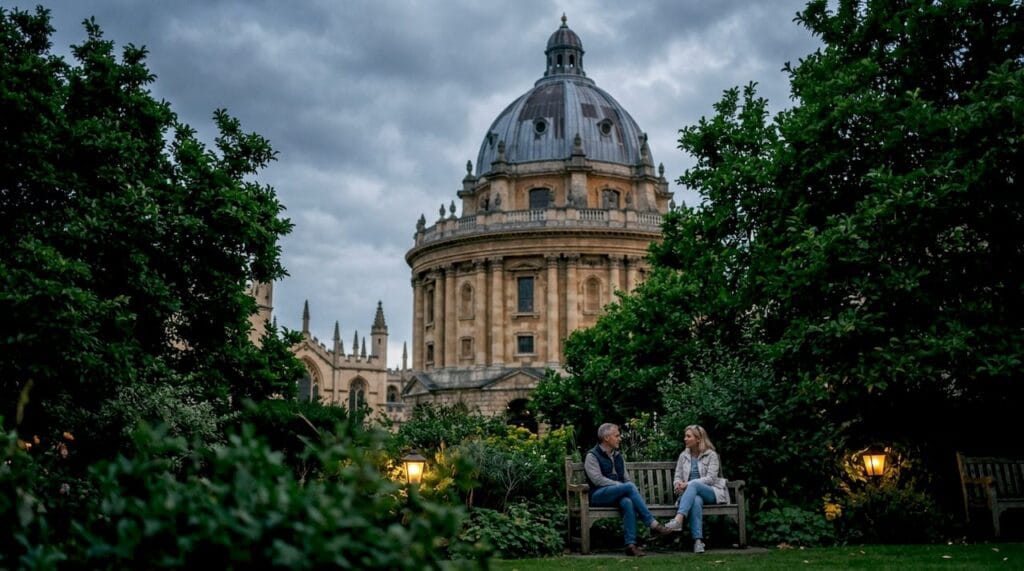
- Radcliffe Camera. The circular reading room, completed in 1749, appears in Pullman’s His Dark Materials and has become a symbol of Oxford’s intellectual identity worldwide.
- Blackwell’s Bookshop, Broad Street. The Norrington Room beneath the shop contains 5km of shelving and over 160,000 volumes, making it the largest single room selling books anywhere in the world.
Oxford’s architecture does something specific for writers. The stone buildings, the enclosed quadrangles, and the proximity of ancient libraries to working lecture rooms create a physical environment where the past feels immediately accessible. That sensation feeds directly into fiction.
How does literary Oxford influence modern literature and tourism?
Oxford is officially recognised as the UK’s top literary destination, with 60% of survey respondents rating its literary scene positively. That recognition reflects both the depth of its historical output and the vitality of its current bookshop culture, literary events, and academic publishing.
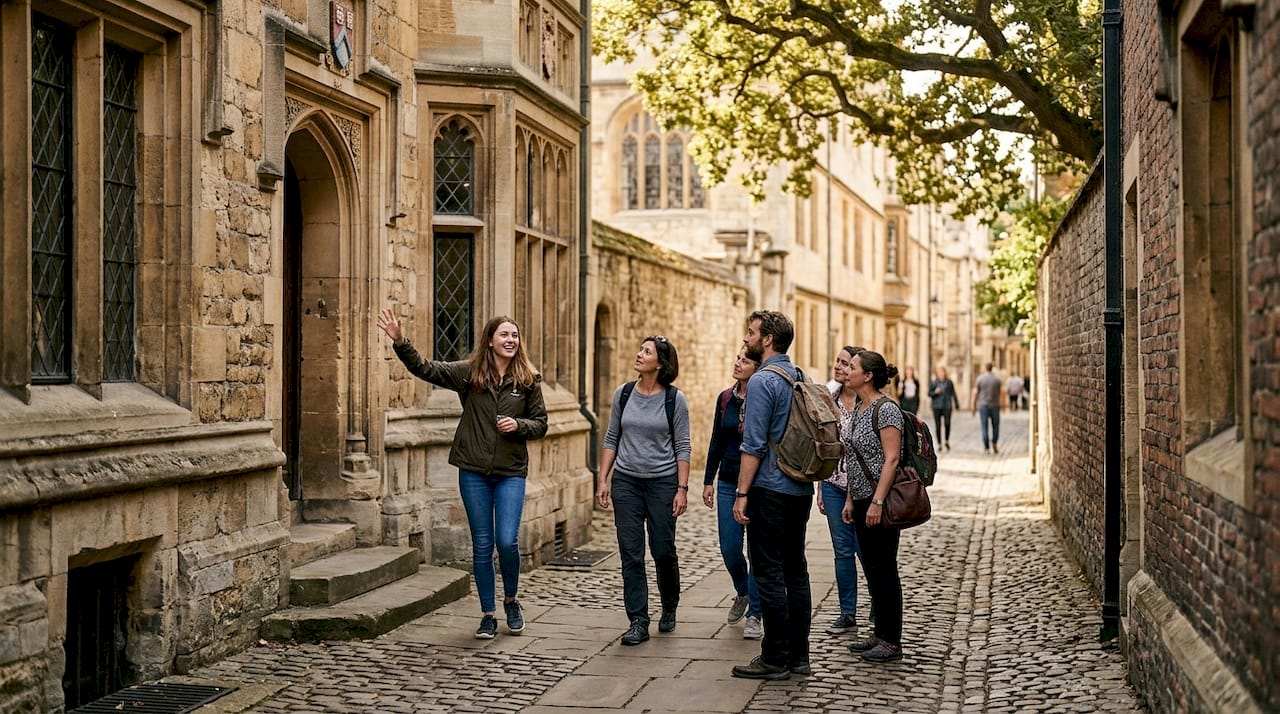
Literary walking tours have become one of the primary ways readers engage with the city’s heritage. Oxford’s walkable scale means a single two-hour tour can connect the Bodleian, the Eagle and Child, Christ Church, and Magdalen without covering more than two miles. The physical experience of tracing authors’ routes through the city changes how readers understand the works those authors produced.
Students engaging with the Oxford literary canon often describe an “implicit weight” from the university’s academic prestige. That weight shapes critical perspectives in ways that can be both inspiring and inhibiting. Recognising it is the first step to engaging with Oxford’s literary tradition on your own terms rather than the institution’s.
Oxford’s literary identity continues to evolve. Philip Pullman’s His Dark Materials brought a new generation of readers to the city in the 1990s and 2000s. The BBC television adaptation renewed that interest sharply. Literary festivals, independent publishers based in the city, and the ongoing work of the Oxford University Press keep Oxford at the centre of British literary culture.
- Oxford’s literary history stretches back to 1768, when the first identifiable Oxford campus novel appeared.
- The city’s bookshop density per square mile is among the highest in Britain.
- Literary tourism in Oxford connects readers to fictional worlds rooted in real architecture, from Tolkien’s Middle-earth to Pullman’s Lyra’s Oxford.
- Academic literary events, including the Oxford Literary Festival, draw writers and readers from across the world each year.
Pro Tip: Visit the types of walking tours available in Oxford before you arrive. Choosing a tour focused on a specific author or period gives you a far more coherent experience than trying to cover everything at once.
Key takeaways
Literary Oxford is defined by the convergence of its collegiate system, its celebrated authors, and its physical landmarks, making it the most concentrated literary environment in Britain.
| Point | Details |
|---|---|
| Collegiate system as foundation | Colleges like Magdalen, Exeter, and Merton created the conditions for Tolkien, Lewis, and Carroll to write. |
| The Inklings’ lasting impact | The group’s meetings at the Eagle and Child directly shaped The Lord of the Rings and Chronicles of Narnia. |
| Unmatched fictional density | At least 533 novels were set in Oxford by 1989, a figure unmatched by any comparable British city. |
| Physical sites carry literary meaning | Locations from the Bodleian to Blackwell’s Norrington Room are active parts of Oxford’s literary identity, not just heritage markers. |
| Literary tourism deepens understanding | Walking tours connect readers to the physical spaces that shaped major works, changing how those works are read. |
Oxford’s literary world: what years of walking these streets taught me
I have walked Oxford’s streets more times than I can count, and the thing that still surprises me is how small it all is. The distance from the Eagle and Child to Magdalen College, where Lewis spent his most productive years, is barely a mile. Tolkien’s rooms at Merton are a ten-minute walk from the Bodleian where he spent decades in the archives. The writers who defined 20th-century fantasy literature were, in a very literal sense, neighbours.
What most literary guides miss is the role of friction in Oxford’s creative output. The Inklings did not simply encourage each other. They argued fiercely. Lewis and Tolkien had a famous falling-out over Lewis’s conversion narrative and his use of allegory in Narnia. That creative tension, produced by proximity and mutual respect, is what the collegiate system generates at its best. You cannot replicate it by reading about it. You have to stand in the spaces where it happened.
The “implicit weight” that students describe when engaging with Oxford’s literary canon is real. I have seen it in the way visitors approach the Bodleian, speaking in hushed tones as if the building itself demands deference. The healthiest way to engage with literary Oxford is to treat it as a living conversation rather than a monument. The writers who shaped this city were not reverential about it. They used it, argued with it, and occasionally fled from it. That is the model worth following.
If you want to understand what makes Oxford’s literary culture genuinely distinctive, attend a literary event in the city and then walk back through the streets afterwards. The combination of ideas heard and stones seen is what Oxford does that nowhere else can.
— Shane
Experience literary Oxford with Oxfordmagictours
Oxfordmagictours offers Oxford city walks that take you through the physical heart of the city’s literary heritage, from the colleges that shaped Tolkien and Lewis to the filming locations that brought Harry Potter to life. The tours are led by a magician who has performed for the British Royal Family and A-list celebrities, making Oxfordmagictours the only walking tour in Oxford to combine live entertainment with genuine historical depth. Whether you are a literature student, a lifelong reader, or a first-time visitor, a guided walk through Oxford’s literary sites gives you a connection to the city’s stories that no book alone can provide. See the full range of walking tours and choose the experience that fits your interests.
FAQ
What is literary Oxford?
Literary Oxford refers to the city’s distinctive identity as a centre of literary production, shaped by the University of Oxford, its colleges, celebrated authors, and historic sites connected to major works of English literature.
Which authors are most associated with Oxford?
J.R.R. Tolkien, C.S. Lewis, Lewis Carroll, Philip Pullman, and Colin Dexter are the most widely recognised authors whose lives and works are directly connected to Oxford.
What were the Inklings?
The Inklings were a literary group centred on Tolkien and Lewis who met regularly at the Eagle and Child pub in Oxford from the 1930s, sharing and critiquing works that included The Lord of the Rings and the Chronicles of Narnia.
Is the Eagle and Child pub open to visit?
The Eagle and Child is currently closed for a major restoration expected to complete around 2027. The Lamb and Flag pub on St Giles’ Street serves as the current alternative with its own Inklings associations.
How many novels are set in Oxford?
At least 533 novels had been identified as set specifically in Oxford by 1989, with the tradition of Oxford campus fiction dating back to 1768.