
Many tourists visit Oxford expecting stunning architecture and historic sites to speak for themselves. Yet without understanding the stories, conflicts, and creative minds that shaped this city over nine centuries, you miss the deeper connections that transform sightseeing into genuine discovery. Immersive walking tours that weave history, literature, and film into engaging narratives create memorable experiences far beyond what guidebooks or maps can offer, making your visit genuinely enriching.
Table of Contents
- How Immersive Walking Tours Bring Oxford’s History To Life
- Why Oxford’s History Shapes Its Literary And Cinematic Allure
- How Expert-Led Tours Elevate Understanding And Enjoyment
- Practical Tips For Making The Most Of Your Oxford History Experience
- Discover Oxford History With Expert-Led Walking Tours
- Frequently Asked Questions
Key takeaways
| Point | Details |
|---|---|
| Immersive tours boost satisfaction | Guided walking tours increase visitor engagement significantly through expert storytelling and multi-sensory experiences |
| History enriches film and literature | Oxford’s 930-year heritage directly inspired Tolkien, Lewis, and became Harry Potter filming locations, adding depth to popular culture |
| Expert guides enhance comprehension | Alumni-led tours improve historical understanding by 25% compared to self-guided exploration |
| Live entertainment creates lasting memories | Theatrical performances during tours boost satisfaction by 40% and emotional connection to history |
How immersive walking tours bring Oxford’s history to life
Historical walking tours in Oxford transform passive sightseeing into active discovery by combining expert storytelling with the city’s remarkable architecture. Rather than simply pointing out buildings, skilled guides reveal the human dramas, intellectual breakthroughs, and creative inspirations that unfolded within these stone walls. This approach helps visitors understand why Oxford became a global centre of learning and creativity rather than just admiring pretty facades.
The inclusion of Harry Potter filming locations adds contemporary relevance to centuries-old sites. Christ Church’s dining hall, the Bodleian Library’s medieval spaces, and New College’s cloisters served as backdrops for the films, creating a bridge between historical significance and modern popular culture. Visitors who recognise these locations from cinema suddenly engage more deeply with the broader history surrounding them.
Small group sizes allow guides to tailor content to visitor interests, whether you’re fascinated by medieval scholarship, literary heritage, or cinematic connections. Unlike coach tours that herd dozens through set routes, intimate walking groups enable questions, discussions, and personalised insights. This flexibility means history enthusiasts can delve into specific periods whilst film fans learn how Oxford’s authentic medieval atmosphere attracted location scouts.
The multi-sensory nature of walking tours engages visitors physically and intellectually. You’re not just hearing about history; you’re standing where it happened, touching ancient stone, and experiencing the spatial relationships between colleges, libraries, and gathering places that shaped intellectual life for centuries.
Pro tip: Book tours during quieter morning hours when colleges are less crowded, allowing better access to courtyards and more intimate storytelling without tourist distractions.
Key elements that make immersive tours effective:
- Expert narration that connects historical events to specific locations you’re viewing
- Visual appreciation of architectural details revealing construction periods and cultural influences
- Cinematic references that help younger visitors engage with older historical contexts
- Interactive elements including live performances that bring historical figures to life
Why Oxford’s history shapes its literary and cinematic allure
Oxford’s status as the oldest English-speaking university, with continuous teaching since 1096, created an intellectual atmosphere that profoundly influenced generations of writers and filmmakers. The medieval collegiate system, rigorous academic traditions, and remarkable architectural preservation provided both inspiration and authentic backdrops for creative works spanning centuries. Understanding this historical foundation helps visitors appreciate why Oxford became synonymous with scholarly excellence and imaginative literature.

JRR Tolkien developed Middle Earth whilst teaching Anglo-Saxon at Oxford, drawing inspiration from the city’s ancient manuscripts and architectural forms. CS Lewis hosted the Inklings literary society in local pubs, debating fantasy and theology with fellow academics. These weren’t tourists passing through; they were residents deeply embedded in Oxford’s intellectual culture, and their works reflect that sustained engagement.
| Author | Notable Works | Oxford Influence |
|---|---|---|
| JRR Tolkien | The Lord of the Rings, The Hobbit | Drew on medieval manuscripts and collegiate architecture for Middle Earth worldbuilding |
| CS Lewis | Chronicles of Narnia, Mere Christianity | Oxford’s tutorial system and intellectual debates shaped his allegorical fantasy |
| Philip Pullman | His Dark Materials trilogy | Set in alternative Oxford, using actual college geography and academic culture |
| Lewis Carroll | Alice’s Adventures in Wonderland | Inspired by Christ Church and mathematical logic studies |
Harry Potter filming at Oxford wasn’t arbitrary; production designers specifically sought locations with authentic medieval architecture that conveyed magical academia. The Bodleian’s Duke Humfrey’s Library became Hogwarts Library because its 15th-century interior genuinely looks like a wizard’s repository. Christ Church’s dining hall influenced the Great Hall design. These connections mean Oxford’s role as a film hotspot stems directly from its preserved historical architecture.
Live storytelling during tours draws explicit connections between historical events and their literary echoes. When guides explain how college life functioned in Tolkien’s era, visitors understand how that environment shaped his fictional Fellowship. When standing in actual filming locations, the relationship between real history and cinematic fantasy becomes tangible rather than abstract.
Pro tip: Research which authors or films particularly interest you before booking, then request that your guide emphasise those connections during the tour for a personalised experience.
Oxford’s literary and cinematic significance stems from:
- Nine centuries of preserved architecture providing authentic historical settings
- Generations of resident scholars and writers deeply embedded in the city’s culture
- Tutorial system fostering intense intellectual exchange that influenced creative works
- Architectural and atmospheric authenticity attracting filmmakers seeking medieval and academic settings
How expert-led tours elevate understanding and enjoyment
The difference between wandering Oxford independently and joining an expert-led tour mirrors the gap between reading a textbook and attending an engaging lecture. Guides don’t just recite facts; they contextualise information, share personal anecdotes from their time as students or residents, and adjust pacing to group interests. This human element transforms information delivery into genuine storytelling.
| Aspect | Self-Guided Visit | Expert-Led Tour |
|---|---|---|
| Historical Context | Limited to plaques and guidebooks | Rich narratives connecting events, people, and places |
| Access | Public areas only | Often includes insider college access |
| Personalisation | Fixed route | Tailored to group interests |
| Comprehension | Relies on prior knowledge | Improves understanding by 25% through expert explanation |
| Engagement | Passive observation | Active questioning and discussion |
| Hidden Details | Easy to miss architectural features | Guides highlight significant but overlooked elements |
Alumni guides bring particular value because they lived within the collegiate system, experiencing traditions and spaces as residents rather than visitors. They share firsthand stories about formal dinners, tutorial pressures, and college rivalries that official histories omit. This insider perspective makes history feel immediate and relatable rather than distant and academic.
The benefits of guided Oxford tours extend beyond information delivery to include practical navigation. Oxford’s college layout confuses first-time visitors, with narrow lanes, private courtyards, and inconsistent signage. Guides efficiently navigate this complexity whilst maintaining narrative flow, maximising your limited time.
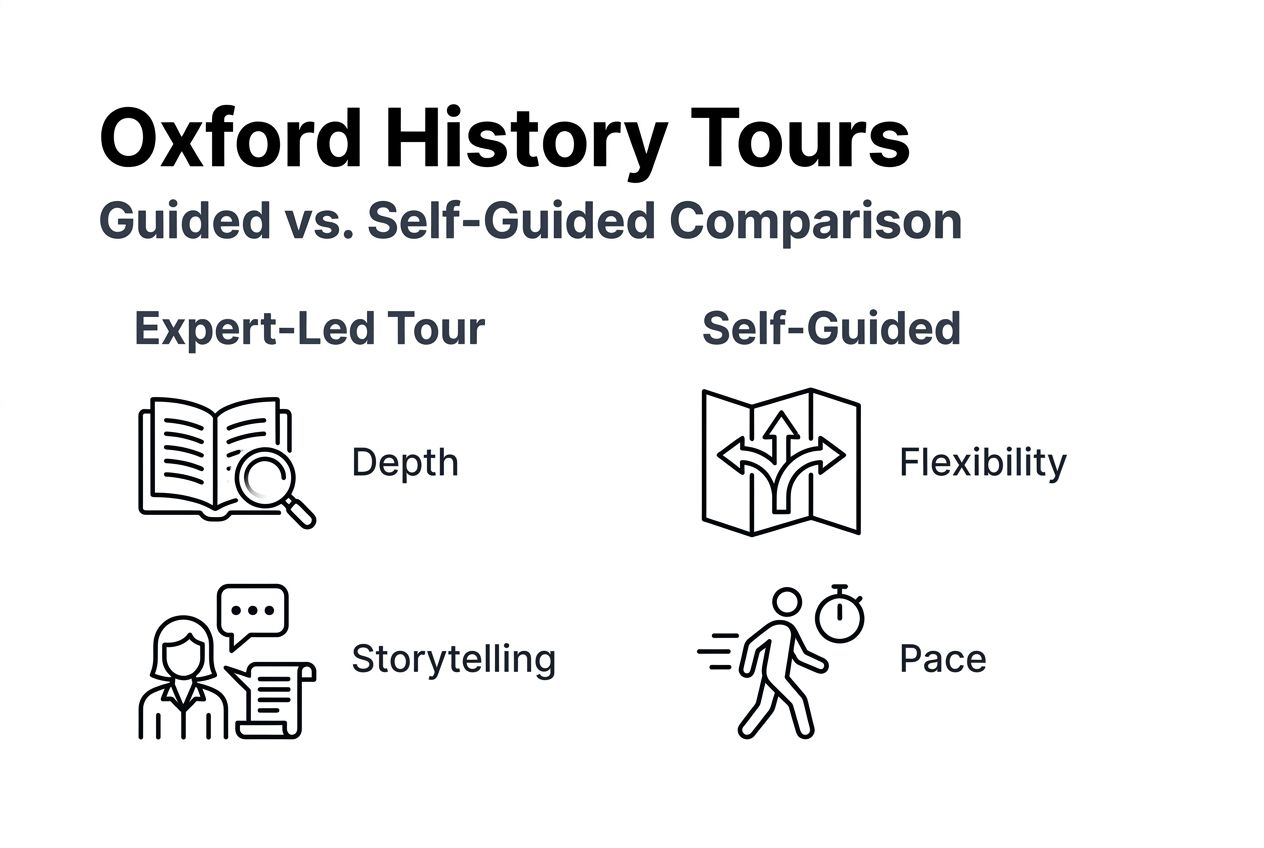
Tailored tours suit specific interests whether you prioritise medieval history, literary heritage, or film locations. Rather than generic overviews touching everything superficially, specialised tours go deeper into particular themes. Film enthusiasts get detailed production stories and filming techniques, whilst literature fans explore the actual rooms where authors worked and socialised.
Pro tip: Choose tours led by Oxford alumni for authentic insider perspectives that transform standard historical facts into lived experiences and personal connections.
Balanced tours avoid overwhelming visitors with dates and names, instead focusing on compelling narratives that make history memorable. Understanding the role of history in Oxford tours means recognising that engagement trumps encyclopaedic detail. Visitors retain stories about people and conflicts far better than lists of monarchs or building dates.
Expert guides enhance experiences through:
- Contextualising historical events within broader cultural and political movements
- Sharing personal anecdotes that humanise historical figures and academic traditions
- Adjusting content depth based on visitor knowledge and interest levels
- Highlighting architectural details and symbolism easily missed without expert guidance
Practical tips for making the most of your Oxford history experience
Selecting the right walking tour requires considering duration, group size, specialisation, and included features. Follow these steps for an optimal choice:
- Verify tour length matches your schedule and stamina; two to three hours provides thorough coverage without exhaustion
- Check maximum group size; smaller groups under 15 people allow better interaction and hearing the guide clearly
- Confirm whether college interiors are included or just external viewing; interior access significantly enriches the experience
- Look for tours featuring live entertainment or theatrical elements that boost engagement beyond standard narration
- Read recent reviews focusing on guide knowledge and ability to answer questions rather than just following scripts
- Ask whether the tour can be tailored to specific interests like literature, film, or particular historical periods
Engaging with live theatrical performances during tours requires openness to interactive elements. Rather than passive watching, these performances often invite participation through questions, simple movements, or imaginative exercises. Embrace this interactivity; it’s designed to create emotional connections to historical figures and events that pure narration cannot achieve.
Accessibility considerations matter for ensuring all visitors can fully participate. Essential features include:
- Wheelchair-accessible routes avoiding steps or offering alternative pathways
- Hearing assistance technology for visitors with hearing impairments
- Rest stops incorporated into longer tours for those with mobility limitations
- Clear communication about physical requirements before booking
Avoid common pitfalls that diminish Oxford history experiences. Tours under 90 minutes rush through content without allowing proper appreciation or questions. Oversized groups make hearing difficult and prevent personalised attention. Generic tours that don’t specialise risk superficial coverage of everything rather than meaningful depth in specific areas. Booking tours without verifying these factors leads to disappointment.
Pro tip: Contact tour operators before booking to request tailoring towards your specific interests in history, literature, or film; most quality providers happily accommodate such requests for better visitor satisfaction.
Why walking tours matter for Oxford visitors becomes clear when you recognise that Oxford’s significance lies in stories, not just stones. Without guides connecting architecture to the human experiences that unfolded within it, you’re seeing impressive buildings without understanding their cultural impact. The investment in a quality guided tour pays dividends in comprehension, engagement, and lasting memories.
Maximising your Oxford experience:
- Book morning tours when sites are less crowded and guides have more flexibility
- Wear comfortable walking shoes; cobblestones and uneven surfaces dominate Oxford’s historic centre
- Bring questions about specific interests; knowledgeable guides welcome engaged curiosity
- Allow time after tours to revisit favourite locations and reflect on what you’ve learned
- Research Oxford’s walking tour options thoroughly before booking to match tours with your specific interests and needs
Discover Oxford history with expert-led walking tours
Oxford Magic Tours offers immersive experiences that bring centuries of history, literature, and film to life through expert storytelling and unique live entertainment. Unlike standard walking tours, these experiences feature award-winning magical performances that create memorable connections between Oxford’s past and present, making history engaging for all ages.
Tour options span historic collegiate architecture, literary heritage sites where famous authors lived and worked, and Harry Potter filming locations that blend cinematic fame with authentic medieval settings. Each tour is led by knowledgeable guides who balance scholarly expertise with entertaining delivery, ensuring you gain genuine understanding whilst thoroughly enjoying the experience.
The inclusion of live magic shows performed by a magician who has entertained British royalty and celebrities adds an extraordinary dimension to historical exploration. These performances aren’t mere distractions; they’re carefully integrated to illustrate historical themes, surprise visitors, and create emotional resonance with the stories being told.
Browse Oxford Magic Tours’ walking tour options to find experiences matching your interests, whether you prioritise medieval history, literary connections, or cinematic locations. Explore Oxford city walks that reveal hidden corners and lesser-known stories beyond the famous landmarks. Discover why Oxford’s Harry Potter locations attract millions of fans annually whilst maintaining their historical integrity and academic function.
Frequently asked questions
What makes Oxford’s history unique compared to other historic cities?
Oxford holds the distinction of being the oldest English-speaking university with continuous teaching since 1096, creating an unbroken intellectual tradition spanning nine centuries. This longevity fostered unique collegiate architecture, rigorous academic culture, and profound literary influence that few cities match. The city’s history intertwines scholarship, creativity, and preserved medieval environments in ways that inspired globally significant literature whilst serving as authentic filming locations for major productions.
How do immersive walking tours differ from self-guided visits?
Guided tours provide expert contextualisation, connecting historical events to specific locations whilst sharing stories that plaques and guidebooks omit. Guides tailor content to visitor interests, answer questions in real time, and highlight architectural details easily missed during independent exploration. Research shows guided experiences improve comprehension significantly compared to self-directed visits that rely on prior knowledge and static information sources.
Can tours include live entertainment and why is it important?
Many Oxford tours now incorporate live theatrical performances or magic shows that add multi-sensory dimensions to historical storytelling. These elements create emotional connections to historical figures and events through surprise, humour, and interactive engagement that pure narration cannot achieve. Studies indicate live entertainment boosts visitor satisfaction substantially by making history memorable and personally meaningful rather than abstractly academic.
Are Oxford’s Harry Potter locations part of history tours?
Yes, quality tours integrate Harry Potter filming locations within broader historical and architectural narratives rather than treating them as isolated attractions. Guides explain why production designers chose specific Oxford sites, connecting the films’ magical academia to the university’s real 900-year scholarly tradition. This approach satisfies film fans whilst educating them about the genuine cultural and historical significance underlying the cinematic fantasy.
How long should an Oxford history walking tour last?
Optimal tours run two to three hours, providing sufficient time for meaningful exploration of multiple colleges, detailed storytelling, and visitor questions without causing exhaustion. Tours shorter than 90 minutes typically rush through content superficially, whilst those exceeding three hours risk fatigue that diminishes engagement. Two-hour tours generally offer the best balance between comprehensive coverage and sustained visitor attention.
What accessibility features should I look for in Oxford tours?
Essential accessibility features include wheelchair-accessible routes that avoid steps or provide alternatives, hearing assistance technology for visitors with hearing impairments, and clearly communicated rest stops for those with mobility limitations. Quality tour operators specify physical requirements before booking and offer modifications to accommodate diverse needs. Always inquire about specific accessibility provisions when booking to ensure the tour matches your requirements.
Recommended
- Role of History in Oxford Tours: Enriching Every Step – Walking tours of oxford
- Important Oxford landmarks list: 40% more engaging tours in 2026
- Oxford University Tours: Hidden Secrets Only Oxford Guides Know (2025) – Walking tours of oxford
- 7 Key Benefits of Guided Oxford Tours for Travelling Tourists – Walking tours of oxford
- 7 Educational Insights from Ontario Historical Sites – The Online Notary