TL;DR:
- Alumni have shaped Oxford’s traditions, buildings, and legends more than its ancient architecture.
- Notable alumni like Tolkien, Lewis, and Pullman turned Oxford into hubs of fantasy and literary worlds.
- Present-day traditions and critiques reflect alumni influence, making Oxford a city of ongoing storytelling and debate.
Many people assume Oxford’s mystique comes from its ancient spires and centuries-old institutions. The truth is more surprising. The legends, traditions, and even the fantasy worlds that draw millions of visitors each year were largely invented, written, and passed down by former students. From Thomas Bodley’s library to J.R.R. Tolkien’s Middle-earth, Oxford’s most enduring magic is alumni-made. This article takes you through the colleges they founded, the traditions they created, the fantasy realms they imagined, and the modern critiques they’ve written — so that when you walk Oxford’s streets, you understand whose footsteps you’re actually following.
Table of Contents
- How alumni founded Oxford’s iconic traditions and colleges
- Famous alumni who turned Oxford into literary legend
- The living heritage: Alumni traditions that shape student life and tours
- Modern alumni: Reimagining Oxford in fantasy and critique
- Why alumni matter more to Oxford lore than you think
- Experience alumni legends on an Oxford walking tour
- Frequently asked questions
Key Takeaways
| Point | Details |
|---|---|
| Alumni are Oxford’s myth makers | From founding colleges to inventing traditions, alumni shape what visitors experience as Oxford lore. |
| Fiction and fact blend on tour | Famous graduates inspired magical stories and legends that feature in guided walks and visitor hotspots. |
| Traditions bring history to life | Centuries-old customs kept alive by alumni are still practised — making Oxford’s legacy feel real and immersive. |
| Modern writers reinvent Oxford | Contemporary alumni like R.F. Kuang challenge and enrich Oxford myths in tours and books. |
How alumni founded Oxford’s iconic traditions and colleges
Oxford’s physical landscape is, in large part, a monument to its former students. Thomas Bodley, an Exeter College alumnus, founded the Bodleian Library in 1602, embedding his legacy into the very heart of the university’s intellectual and cultural identity. That library now features on almost every guided tour of the city, and for good reason. It is one of the oldest libraries in Europe and a filming location for the Harry Potter series.
Other alumni founders left equally powerful marks. Consider the contrast between a few key figures:
| Founder | College founded | Alumni connection |
|---|---|---|
| Thomas Bodley | Bodleian Library | Exeter College alumnus |
| Thomas Pope | Trinity College | Oxford-educated lawyer |
| William Waynflete | Magdalen College | Former Oxford scholar |
| Dorothy Wadham | Wadham College | Founded in memory of Nicholas Wadham |
The Wadham founders’ monuments are among the most visited tour highlights, blending personal history with architectural beauty in a way that few other Oxford landmarks manage. These are not just statues. They are the physical proof of how deeply personal investment shaped a world-class institution.
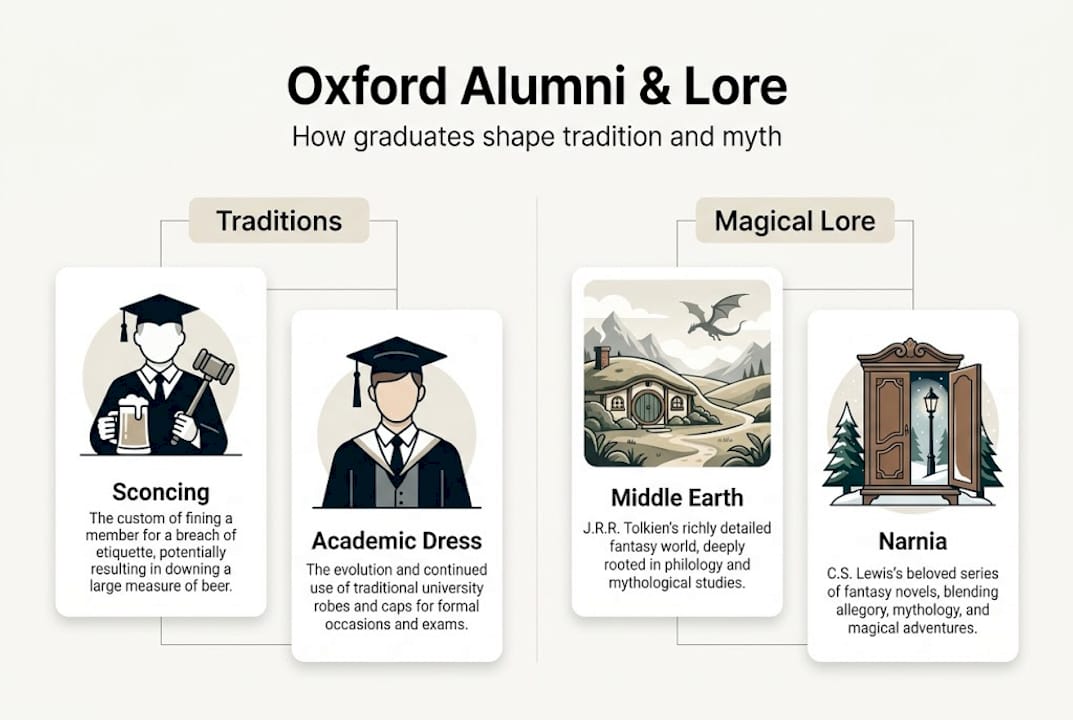
Beyond bricks and mortar, alumni are responsible for some of Oxford’s most beloved customs. Sconcing, the tradition of imposing a dining penalty on a fellow student for a social infraction at the table, is one of the quirkiest and most enduring. College families, where senior students informally mentor newer ones, and the elaborate rituals around academic dress all trace their roots to generations of students who decided these things mattered and kept them alive.
Here are some of the most notable alumni-driven contributions to Oxford culture:
- Bodleian Library: Founded by Thomas Bodley, now a globally recognised research and filming landmark
- Sconcing tradition: A dining custom with alumni origins still practised in many colleges
- College families: Informal mentorship networks passed down through student generations
- Architectural dedications: Statues, portraits, and named halls honouring founding alumni
If you want to see this history come alive, historical walking tours of Oxford are the most direct way to connect the names on the walls with the stories behind them.
Pro Tip: Not every college founder was an Oxford alumnus, which makes the ones who were particularly significant in terms of lore. When your guide mentions a founder, ask whether they actually studied here. The answer often changes the story entirely.
Famous alumni who turned Oxford into literary legend
With alumni shaping Oxford’s fabric, it is no wonder its graduates fuel not just bricks and mortar, but entire worlds of fantasy. The most famous example is the Inklings, an informal literary group whose members included J.R.R. Tolkien and C.S. Lewis, both Oxford alumni who met regularly at the Eagle and Child pub on St Giles’ Street. Their conversations over pints produced The Lord of the Rings and The Chronicles of Narnia. That pub is now a storytelling tour staple, and rightly so.
The data speaks for itself when you look at the literary output connected to Oxford alumni:
| Author | College | Work inspired by Oxford |
|---|---|---|
| J.R.R. Tolkien | Exeter College | The Lord of the Rings |
| C.S. Lewis | Magdalen College | The Chronicles of Narnia |
| Philip Pullman | Exeter College | His Dark Materials |
| R.F. Kuang | University College | Babel |
Philip Pullman, an Exeter College alumnus, modelled Jordan College in His Dark Materials directly on his own Oxford experience. Walk past Exeter College today and you are essentially walking past the fictional Jordan College. It is that close. R.F. Kuang’s impact on how visitors understand Oxford is covered in more detail below, but her work adds a sharp contemporary edge to this literary tradition.
For those who want to understand C.S. Lewis in Oxford more deeply, the connections between his life here and the worlds he created are genuinely astonishing. His rooms, his favourite walks, and his friendships with fellow alumni all fed directly into Narnia.
‘Oxford is as much invention as reality — its alumni are its greatest myth makers.’
What makes this particularly compelling for tour visitors is that these are not distant historical figures. Their books are still being read, their fictional Oxfords are still being imagined, and the magical secrets of Oxford that inspired them are still visible on every corner.
- The Eagle and Child pub, where the Inklings met, is a short walk from several colleges
- Exeter College chapel features a tapestry that influenced Tolkien’s visual imagination
- Magdalen College’s deer park and grounds fed directly into Lewis’s descriptions of Narnia
- Pullman has spoken publicly about how Oxford’s streets shaped his fictional geography
The living heritage: Alumni traditions that shape student life and tours
As Oxford’s stories are told in books and buildings, so too are they enacted daily through tradition, ensuring alumni influence is a lived reality rather than a museum piece. The traditions alumni perpetuate include sconcing, subfusc academic dress, college families, and the famous Torpids bumps races on the River Cherwell. These are not performances for tourists. They are genuine customs that current students practise because previous generations handed them down.
Here is a quick guide to the four most visitor-relevant traditions:
- Subfusc: The formal academic dress worn for exams and matriculation. Visitors often catch students in full subfusc near the Bodleian, particularly in spring and autumn. Subfusc academic dress has been required since the 17th century.
- Sconcing: A dining penalty tradition where a student must drink from a large vessel if they break a dining rule. The sconcing tradition dates back to at least 1617, making it one of Oxford’s longest-running alumni customs.
- College families: Senior students adopt junior ones as informal academic family members, creating support networks that persist long after graduation.
- Torpids bumps races: Rowing races on the Cherwell where boats attempt to ‘bump’ the one ahead. Crowds gather on the banks and the atmosphere is unlike anything else in Oxford.
The statistic worth noting here is striking. Since 1617, sconcing has continued without interruption, a direct line from alumni of four centuries ago to the students sitting in dining halls tonight.
For those curious about Oxford traditions for visitors, understanding the role of history in Oxford tours makes each custom far richer when you encounter it in person.
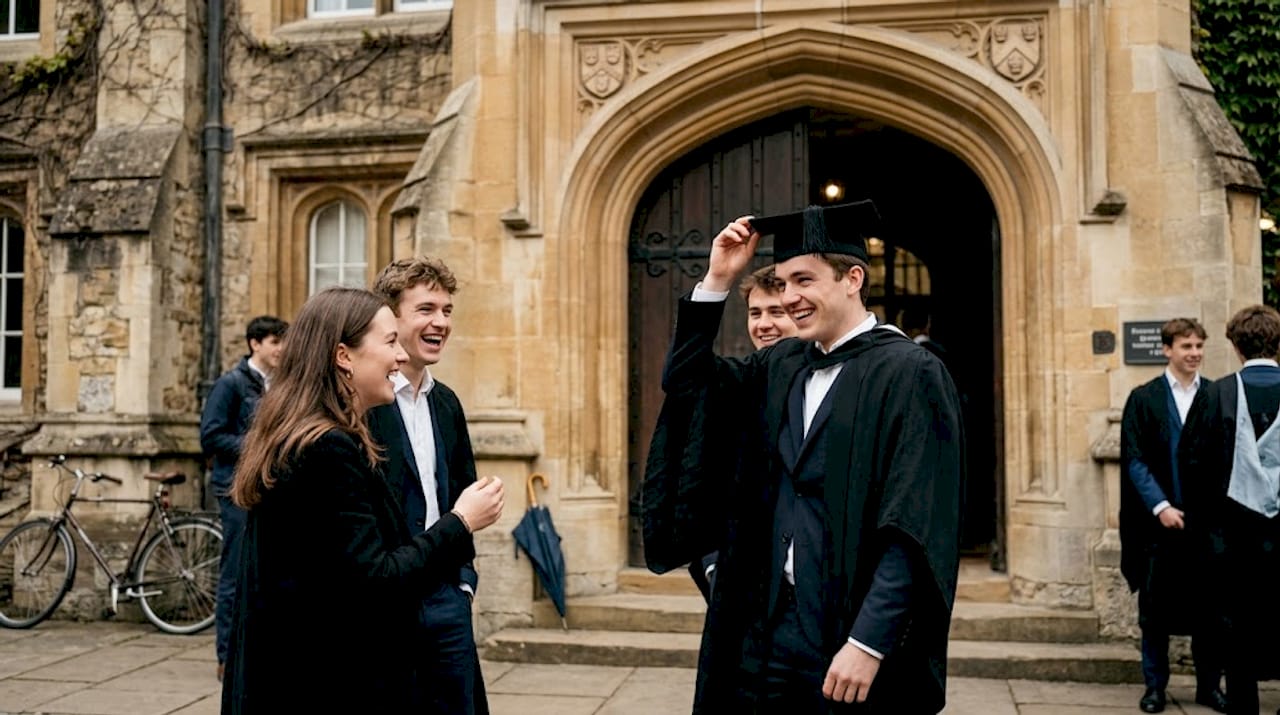
Pro Tip: Ask your guide when and where you might spot genuine traditions like academic dress rituals. During exam season, the streets near the Examination Schools on High Street become an impromptu theatre of subfusc, flowers, and celebration.
Modern alumni: Reimagining Oxford in fantasy and critique
As new generations enter Oxford’s halls, the legends adapt, showing that alumni keep reinterpreting what the city means. The most striking recent example is R.F. Kuang, a University College alumna whose novel Babel critiques imperialism through Oxford, using the city’s actual architecture and geography as the backdrop for an alternate history of British colonial power. The Babel Institute in her novel sits at the heart of Oxford’s real landmarks, making the city simultaneously familiar and deeply unsettling.
This matters for tour visitors because guides are increasingly weaving Kuang’s commentary into their narratives. Oxford is no longer presented purely as a place of wonder and tradition. It is also a place of debate, where the legacy of empire, elitism, and exclusion sits alongside the beauty of its quads and libraries.
‘Alumni authors gift visitors an Oxford richer in imagination, but also more open to critique.’
Modern alumni are opening conversations that older tour narratives often avoided:
- Babel’s geography: Kuang maps fictional events onto real Oxford streets, making her novel a kind of alternative guidebook
- Elitism and access: Alumni writers increasingly address who Oxford was built for and who it excluded
- Magic as metaphor: Fantasy and alternate history become tools for examining real institutional power
- Living critique: Unlike historical figures, Kuang is an active public voice, and her perspective continues to evolve
For those interested in touring Oxford’s magical side, understanding Oxford’s unique identity through both its celebratory and critical alumni voices gives you a far more complete picture of what this city actually is.
Why alumni matter more to Oxford lore than you think
Here is something most Oxford guides will not say directly. The buildings would be empty symbols without the people who studied in them and then went on to reinvent what those buildings meant. Oxford’s administration maintains the institution. Its fellows conduct the teaching. But it is the alumni who generate the stories, and stories are what bring visitors from every corner of the world.
Tolkien did not just study at Exeter College. He transformed it into a place of mythological significance for millions of readers who have never set foot in Oxford. Pullman did the same. Kuang is doing it now, from a very different angle. Each generation of alumni adds a new layer, and that accumulation is what makes Oxford feel genuinely inexhaustible as a destination.
The uncomfortable truth is that a tour of Oxford without alumni context is just a tour of old buildings. It is the human stories, the rivalries, the friendships, the books written in cold rooms, the traditions invented out of mischief or reverence, that give those buildings meaning. Understanding the historical context for visitors transforms a pleasant afternoon into something you will still be thinking about months later.
Visitors connect most deeply when they realise they are not passive observers of someone else’s history. They are the next chapter. Every person who walks through Oxford’s streets and carries a story home is, in a small way, doing exactly what the alumni have always done.
Experience alumni legends on an Oxford walking tour
If you are ready to see the alumni impact for yourself, the best way is on foot with an expert guide. Our Oxford walking tours take you directly to the places where these legends were made: the pub where Tolkien and Lewis debated mythology, the college that inspired Jordan College, and the library that a former student built for the world. We also cover the Harry Potter locations that connect fictional magic to real alumni history. For a deeper experience, our exploring Harry Potter’s Oxford tour is a favourite with literary fans. You can also explore Oxford’s colleges with live entertainment from a magician who has performed for the British Royal Family.
Frequently asked questions
Which Oxford college has the most famous alumni for lore lovers?
Exeter College (Tolkien, Pullman) and Magdalen (C.S. Lewis) are central to many legends, with both colleges directly inspiring fictional worlds. The Inklings’ legacy makes these two colleges essential stops for any literary tour.
Can visitors witness original alumni traditions at Oxford today?
Yes, you can often see academic dress during matriculation and exams, and learn about traditions like sconcing on public or guided tours. The alumni traditions at Oxford are still actively practised by current students.
Are alumni stories included in most guided Oxford walking tours?
Absolutely. Alumni legends, from J.R.R. Tolkien to C.S. Lewis and R.F. Kuang’s Oxford, are core material for themed and historical tours, particularly those focused on fantasy and literature.
What’s the best way to find magical or literary locations inspired by alumni?
Book an Oxford walking tour focused on fantasy or literature to see alumni haunts like the Eagle and Child pub and the real places behind fictional colleges. A specialist guide brings the connections to life in ways a map simply cannot.